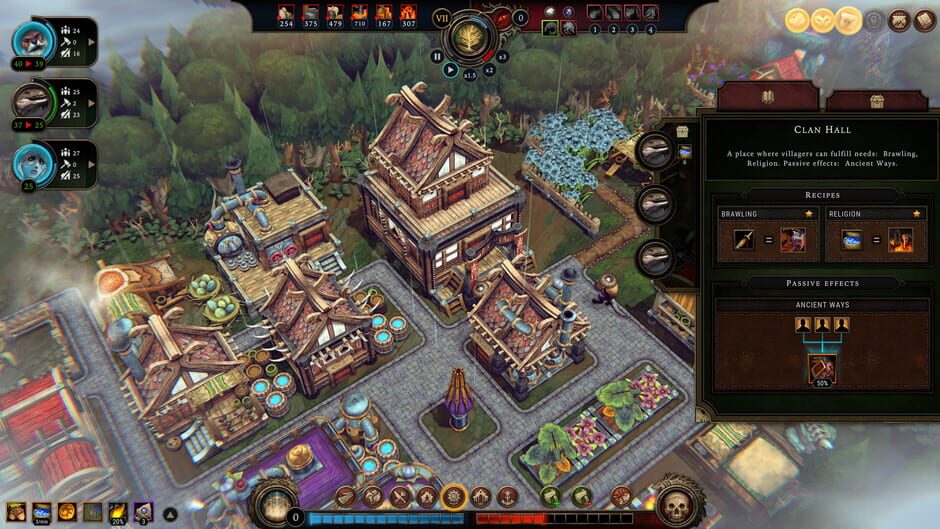
A masterclass in strategy design, Against the Storm delivers an unforgettable experience from start to finish.
93
Verdict
95%
Steam
91
IGDB
Verdict score based on confidence-adjusted Steam reviews?
Very Positive on Steam (95% positive from 36K reviews)
Healthy player count of 1,036 concurrent
Critically acclaimed (91/100 critic average)
Rich open world to explore
Still in Early Access — content may be incomplete
A roguelite city builder set in a fantasy world tormented by the everlasting rain. Settle the unknown wilds to discover and rebuild the ruins of a long-forgotten civilization. Develop technologies that will help your citizens tackle destructive storms and extend the frontier of your civilization.
Runs well on modern hardware.
Updated 3h ago
AtS is best described as "roguelike with city builder mechanics". I say this because there seems to be a consistent confusion in about 5% of players that this is "a citybuilder with some randomness elements". That is not the case. This is a roguelike, with a 1-3h run loop, lots of RNG, many runs - don't get attached to your settlement. Beneath that are the mechanics of a citybuilder rather than a turn-based game, hack'n'slay or otherwise, which sets it apart. The gameplay simplified: You embark on a settlement, selecting a few starting goods. You play through the early and mid-game of a citybuilder, while battling the environment which is trying to kill your villagers or make them leave. There is A LOT of randomness, perks, blueprints, what resources you find, what events you find, what mysteries are active, etc. Your job is to make the best of it, keep your people happy (so they earn reputation passively) and try to fulfill orders. You earn reputation, once full you win. Impatience creeps up, if full you lose. Each settlement can grant you boons that last for the rest of the 'cycle'. The cycle has a limited duration and you preferably want to end it by reforging a seal. If you take 5 years to complete a settlement it costs you 5 years of the cycle timer, so faster is better. Making the most productive/nicest city is not a goal here that is rewarded. Boons don't carry over between cycles. However, citadel upgrades do and are permanent unlocks. There is also 'queens hand trial' a full roguelike mode with random citadel unlocks and permadeath. As for an actual review: I personally love the game, because it isn't just another citybuilder. It also isn't an average roguelike because the game underneath it is a genre that is rarely combined with any roguelike elements, much less the full roguelike experience. Every game is a new challenge of figuring out how to win fast, because winning is half the battle, not spending 8+ years in a settlement is the other half. The game will start you off with four difficulties to get acquainted, but there is 20 prestige levels, each making the game a bit harder. So there is a very gradual difficulty curve, if you take your time to learn the basics on the lower difficulties. The game is deep and somewhat complex, so it isn't something you master in one cycle.
Against the Storm is probably the most unique city builder out there. It is beautiful, challenging has a nice soundtrack and the progression system makes you want to continue learning and evolving. Definitely recommend this for anyone who is interested in the genre. Developers who still create games as a labor of love, not profit, deserve praise.
I've given 60+ hours of my life to this game thus far and now feel I have at least a credible opinion on whether you should play this. Many people have already commented that this isn't a city builder, but should be considered a rogue-lite with city builder elements. I would agree with this point wholeheartedly; ironically, while I feel this could be a turn-off for some folks, it's actually what keeps me coming back for more. The basics are this: you are a viceroy tasked with saving the kingdom from the impending storm. The queen has commanded you venture forth, building necessary supply lines to restore seals that keep the storm active. To do this, you must build small, successful villages that make a continuous supply chain to the seal location, then you attack the monsters that guard them. If you fail to develop your town supply line in time, the queen's impatience eventually becomes overwhelming, resulting in your being recalled to the capital for what I can only assume is a thrashing and trying again within the timeframe allowed before the storm comes to overwhelm and destroy. It's a simple premise, but where AtS shines is in the execution. There are numerous optimizations and modifications to this formula, including intentionally building your towns near modifiers to increase your rewards for success. It has just enough RNG to keep it fresh (and frankly feeling like a viceroy under pressure to meet royal demands). There a deep system of knowledge that will help you successfully navigate completing your victory conditions before the queen is outraged at your dallying. There are multiple ways to do this: make a paradise on earth for your pilgrims, complete specific objectives the queen has requested, or completing events in hidden locations called 'glades' that will appease her wrath. All of these conditions will need to be met as quickly as you can manage, since the time you spend achieving victory will put you that much closer to the storm sweeping all of your hard work away. The are a lot of options for customizing the experience and innumerable shortcuts to optimize your build strategy. They thought of nearly everything I would normally have niggling complaints about: speeding up time to make city development faster, easy focus of harvesting specific resources and applying production enhancements, hotkeys for quickly identifying and assigning resources (all praise the Alt key), and little QoL options to avoid actions you didn't plan, such as breaking into a glade before you're ready from your woodcutters or preventing your villagers from eating resources used for upgraded food types. You can even say most of these customizations to use them over and over in future villages. I can tell when I enjoy a gaming experience based on the intensity with which I focus to complete a mission and whether I'm passively listening to other things, like podcasts, while I do it. With Against the Storm, I have always found myself craned over my keyboard for an hour or two carefully planning out and watching my settlement develop, feeling that sense of desperation trying finish my reputation requirement before the queen is finally fed up with my ineptitude, all without noisy distractions bothering me as I think through my strategy. It's a marvelous and engaging, something I have rarely felt since my younger days when video games were newer and people with passion produced them. Would I recommend Against the Storm? Yes. A lot. If city building is within the sphere of genres you enjoy (and even if it isn't but enjoy tactical rogue-likes), it is absolutely worth the investment.
Reviews sourced from Steam. All reviews belong to their respective authors.
Data sourced from RAWG, Steam, IGDB, CheapShark, Wikipedia, HLTB, and GX Corner. Sources: rawg, steam, cheapshark, igdb.
All game titles, trademarks, and copyrights belong to their respective owners.
