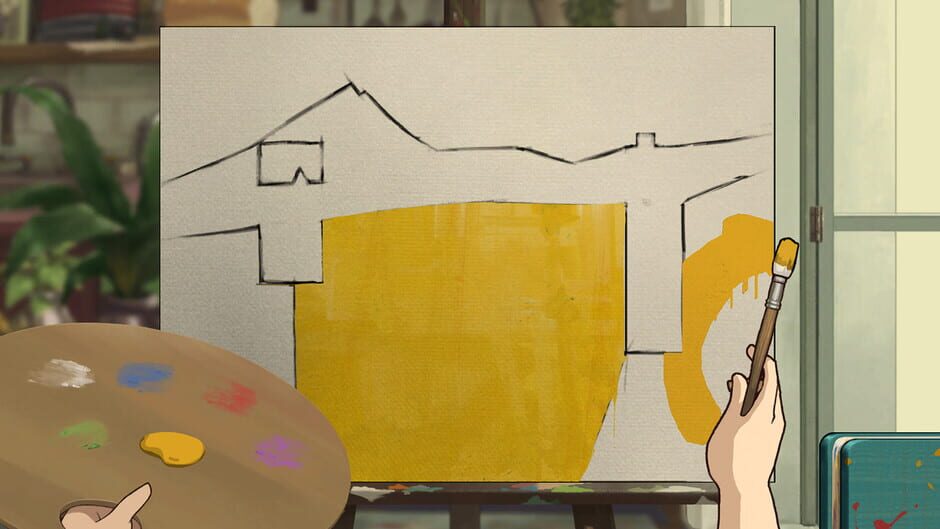
With near-perfect execution, Behind the Frame: The Finest Scenery is a must-play for any adventure fan.
93
Verdict
94%
Steam
—
IGDB
Verdict score based on confidence-adjusted Steam reviews?
Very Positive on Steam (94% positive from 7.4K reviews)
Compelling narrative and story
Outstanding soundtrack
Limited professional critic coverage
Behind the Frame: The Finest Scenery is a point and click adventure game created by Taiwanese developer Silver Lining Studio, and co-published by Akupara Games and Akatsuki Taiwan Inc. The game was released for Microsoft Windows, macOS, iOS, and Android in August 2021, then for Nintendo Switch and PlayStation 4 in June 2022.

Runs well on modern hardware.
Last updated 11h ago
[h1] Behind the Frame: The Finest Scenery — When Color Finds Its Way Back to Memory [/h1] [b] [i] “Some colors are not lost, they are only waiting to be remembered.” [/i] [/b] Some games win you over with sprawling lore. Others hook you with adrenaline-fueled combat systems. Behind the Frame: The Finest Scenery needed none of that — just two hours, one studio apartment, a single window, and a mischievous orange cat, and I still couldn’t get up from my chair after the credits rolled. Crafted by Taiwan’s Silver Lining Studio, this small puzzle-narrative game carries an ambition far larger than its runtime suggests: it wants to show us how memory, through the act of painting, slowly becomes whole again. [h2] Interaction Design: To Solve Is to Undergo Emotional Rehabilitation [/h2] [b] [i] “To solve is to remember, and to remember is to heal.” [/i] [/b] The interactive core of Behind the Frame is deliberately restrained — click, drag, color, sketch, mend. There is almost no failure state, no punishment mechanic, no timer chasing you down. Players are never scolded for a wrong guess. At first I mistook this “zero- pressure” design for a simple concession to casual audiences. It was only in the later chapters that I understood it as a narrative necessity — the painter you’re playing is someone frozen, someone trapped in her own psychological stasis. The game doesn’t need failure-and-retry loops to generate anxiety; what it needs is patience, permission for the player to piece the shattered picture back together slowly, the same way she does. The core mechanic — hunting for pigment, restoring damaged paintings — is itself the game’s most elegant metaphor. You believe you’re simply finishing a piece for an exhibition submission; in truth, every mixed color, every restored patch of canvas is a forgotten memory being repainted, stroke by stroke. The puzzles are never isolated set-pieces divorced from their surroundings — they’re woven tightly into the everyday objects of the studio and the quiet rhythms of the old man painting across the window. This “environment- as-puzzle, puzzle-as-narrative” design keeps interaction entirely in service of emotion rather than becoming a distracting brain-teaser sideshow. The 360-degree panoramic navigation adds another layer to what could have been a monotonous single-room exploration — you’re not “clearing a level,” you’re standing still while memory surrounds you. [h2] Narrative Analysis: A Farewell You Must Piece Together With Your Own Hands [/h2] [b] [i] “Behind every frame, a heart still waiting to be found.” [/i] [/b] What’s most remarkable about this work is how it tucks a heavy meditation on loss and farewell inside a deceptively light, everyday framework. The story opens almost mundanely: a painter, racing to finish a piece for a New York exhibition, shuts herself inside her studio. Coffee each morning, breakfast, painting, repeat — her only distraction the eccentric old man across the way and the orange cat he keeps. Slowly you notice that his paintings keep returning to the same scene: a young man and woman, meeting, coming to know each other. And somewhere in your own studio, fragments of that same scene seem to already exist. The true turning point arrives when the old man suddenly collapses. The painter tries to rush outside to help — only to discover she cannot leave the studio at all. A new room has appeared out of nowhere, a nameplate on its door reading “Amber” — the very name of the young woman in the old man’s paintings. As the player restores canvas after canvas inside that room, the truth surfaces gradually: the painter herself is Amber. She was never an outside observer of someone else’s story — she has been, all along, painting her way back to a memory that was once her own, and had slipped away. This “narrator is the subject” twist never arrives through a single expository line. Instead, it’s assembled by the player’s own hands, one completed painting at a time — what you restore isn’t someone else’s past, it’s your own life. This technique, where the act of solving is the act of revelation, roots the story’s entire emotional weight in the player’s participation rather than in a passively-watched cutscene. And the relationship between that “eccentric old neighbor” outside the window and the young man inside the paintings finds its heartbreaking answer in this same moment — all those seemingly unrelated everyday fragments were, from the very beginning, pointing toward one single truth: [spoiler] [b] some people simply choose a different way to stay beside you. [/b] [/spoiler] [h2] Visual Design: Color as Memory, Brushstroke as Heartbeat [/h2] [b] [i] “Every stroke is a memory refusing to fade.” [/i] [/b] If the narrative is this game’s soul, its hand-painted art is its bones and blood. Rendered entirely in frame-by-frame hand-drawn animation, the visuals carry a warm, tactile quality — light shifts with the passage of time, the cat stretches on the windowsill, steam curls up from a coffee cup. These small, unremarkable, deeply true-to-life details keep the studio — a space you essentially never leave — alive and breathing rather than feeling confined by its own limits. Even more impressive is how the game wields color as its central image. The screen is never uniformly vivid from start to finish; unretrieved memories render in a muted, faded gray, and each solved puzzle bleeds fresh color back into some corner of the scene. This “visual progression as narrative progression” design communicates the game’s theme more directly than any line of text could — [b] the return of memory is itself a slow, radiant act of repainting the world. [/b] The panoramic compositions do their share of the work too, turning every room into something you can stand inside and simply behold, like a still life you’re allowed to walk into. Paired with a restrained, wistful score, the game builds an atmosphere caught somewhere between “video game” and “gallery exhibition,” one that asks you to slow down and really look at what’s hiding in every detail. [h2] Closing Thoughts [/h2] [b] [i] “The finest scenery was never outside the window — it was the moment you chose to remember.” [/i] [/b] [b] My score: 6.5 out of 10. [/b] It isn’t a puzzle game built to make your brain hurt. Its puzzles are gentle almost to a fault, yet they serve the story with precision. Its plot doesn’t chase a twist for shock value — it lets the player physically rebuild a memory with their own hands, which is exactly what makes the emotional payoff feel so earned. Its art doesn’t chase visual spectacle — it tells an entire story about love and forgetting through nothing more than a gradual bloom of color. A runtime of an hour and a half to two hours might draw complaints about value for money from some players. But for me, a good story was never measured in hours. This game convinced me that some scenery, glimpsed only for a fleeting moment through a window frame, can still be gently remembered for an entire lifetime.
When I first played the game, I felt like I was watching an animated movie instead of playing a game. I play as a young artist who is preparing a painting for an art exhibition. As I paint and solve puzzles, I slowly discover her memories and her special connection with an elderly artist who lives nearby. The best part of the game for me was the art style and the emotional story. Every scene was so beautiful, and the music made the game feel warm and peaceful. I loved exploring the apartment because every little detail felt meaningful. The relationship between the young artist and the elderly painter was also very touching. It reminded me how art can hold memories and connect people. I also really enjoyed the simple and relaxing gameplay. Most of the time, I was painting, sketching, solving small puzzles, and doing little daily activities. The puzzles were easy to understand, and I liked that the game focused more on the story and atmosphere instead of being challenging. I played this game a long time ago, but I still remember how much I enjoyed it. Highly recommend it!
Behind the Frame: The Finest Scenery is a cute short little point & click game with puzzle elements. I really liked the art style, atmosphere, and music. It is definitely worth it when it is on sale.
Reviews sourced from Steam. All reviews belong to their respective authors.
Data sourced from RAWG, Steam, IGDB, CheapShark, Wikipedia, HLTB, and GX Corner. Sources: rawg, steam, cheapshark, igdb, wikipedia.
All game titles, trademarks, and copyrights belong to their respective owners.