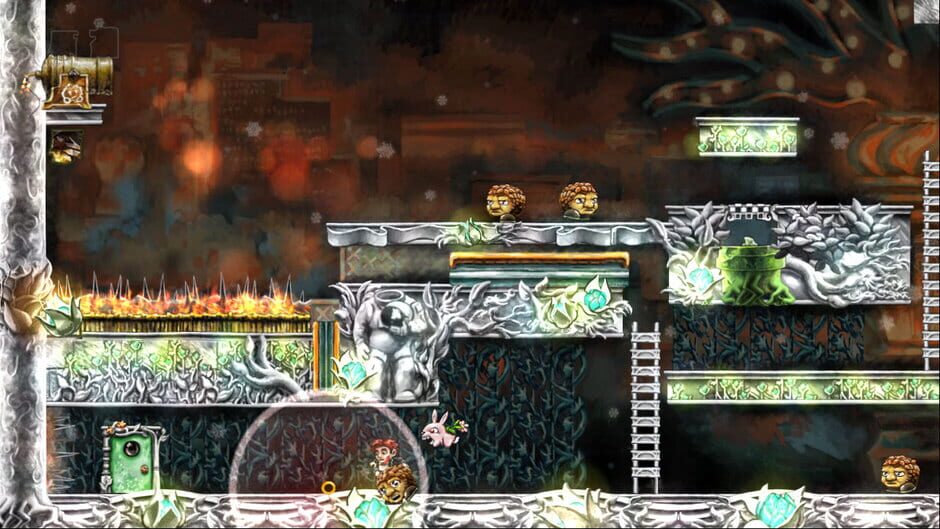
Braid stands out as one of the best Action/Arcade titles in recent memory.
92
Verdict
93%
Steam
87
IGDB
Verdict score based on confidence-adjusted Steam reviews?
Very Positive on Steam (93% positive from 10K reviews)
Critically acclaimed (87/100 critic average)
Compelling narrative and story
Outstanding soundtrack
Steep difficulty curve may not appeal to casual players
Braid is an indie puzzle-platform video game developed by Number None. The game was originally released in August 2008 for the Xbox 360's Xbox Live Arcade service. Ports were developed and released for Microsoft Windows in April 2009, Mac OS X in May 2009, PlayStation 3 in November 2009, and Linux in December 2010. Jonathan Blow designed the game as a personal critique of contemporary trends in video game development. He self-funded the three-year project, working with webcomic artist David Hellman to develop the artwork.

Runs well on modern hardware.
Last updated 18d ago
Braid is a typical platformer that ends up surprising you thanks to a very particular mechanic: Pressing a button rewinds time, and there are mechanics surrounding this (In some levels you rewind yourself but not certain elements in the background, in others only you rewind, in others everything, etc). I'm sure you already know all of this, TLDR: it's a game I highly recommend. The only thing I can't stand, but which is outside the scope of the game itself, is the pretentiousness surrounding it. The game and its fans reek of the edgiest and weirdest things from the early 2010s, for better or for worse. I feel that sometimes a game exists with a grat mechanic and that's it; the curiosities behind it are just that—curious. I say this in case you play it and don't like it, so you know that even today you'll still get flak for saying so out loud.
Braid appears to be a work best appreciated under altered states of consciousness, perhaps by those indulging in alcohol or cannabis. Its protagonist resembles a peculiar, postmodern reinterpretation of Mario: a small, orange-haired gentleman dressed in formal business attire, complete with suit and tie, wandering through an abstract platforming world. At first glance, the game presents itself as a simple exercise in traversal — one moves, jumps, and interacts with the environment — yet its purpose is not immediately evident. The most notable mechanic is its manipulation of time: the player may reverse events, undo mistakes, and repeatedly revisit prior moments. This temporal reversal is undeniably amusing and unusual. Nevertheless, despite this clever gimmick, the overall experience strikes one as profoundly absurd. The game’s structure seems obscure, its objective unclear, and its meaning elusive. In more direct terms: while the rewind mechanic is entertaining, the game itself appears nonsensical, perhaps even “stupid as hell,” with no immediately discernible point.
I'd like to say that I don't think Braid respects your time. For a game where the main mechanic is rewinding time if you make a mistake instead of starting over, there sure are a lot of things that require you to start over. I frequently, in my short experience with the game, had to waste a lot of time restarting and trying multiple times to get the execution of a puzzle just right, after I'd already solved it. That's puzzle design 101, Jonathan Blow, that feels awful. But what's probably more accurate to say is that I'm not smart enough for Braid. After getting frustratingly stuck on an optional puzzle in a stage, I decided to just move on and complete the levels. And then I completed the entire next world in 2 minutes. I realized that just getting to the end of the stage is not a puzzle in Braid, and when these optional puzzle pieces whose function hasn't been explained to me are the only real gameplay, I feel ridiculed by the game for not being able to solve them. I think my real issue with Braid is that the game expects you to view it as a masterpiece. It's almost a foregone conclusion for the game that you think its an artistic achievement, and thus it can do no wrong. That's bold, and from the general consensus, it seems like it worked. But maybe I'm just not smart enough to see its genius.
Reviews sourced from Steam. All reviews belong to their respective authors.
Data sourced from RAWG, Steam, IGDB, CheapShark, Wikipedia, HLTB, and GX Corner. Sources: rawg, steam, cheapshark, igdb, wikipedia.
All game titles, trademarks, and copyrights belong to their respective owners.