Cabernet is an exceptional Adventure/RPG that raises the bar for the genre.
93
Verdict
95%
Steam
90
IGDB
Verdict score based on confidence-adjusted Steam reviews?
Very Positive on Steam (95% positive from 2K reviews)
Critically acclaimed (90/100 critic average)
Compelling narrative and story
Standout indie gem
No significant drawbacks reported
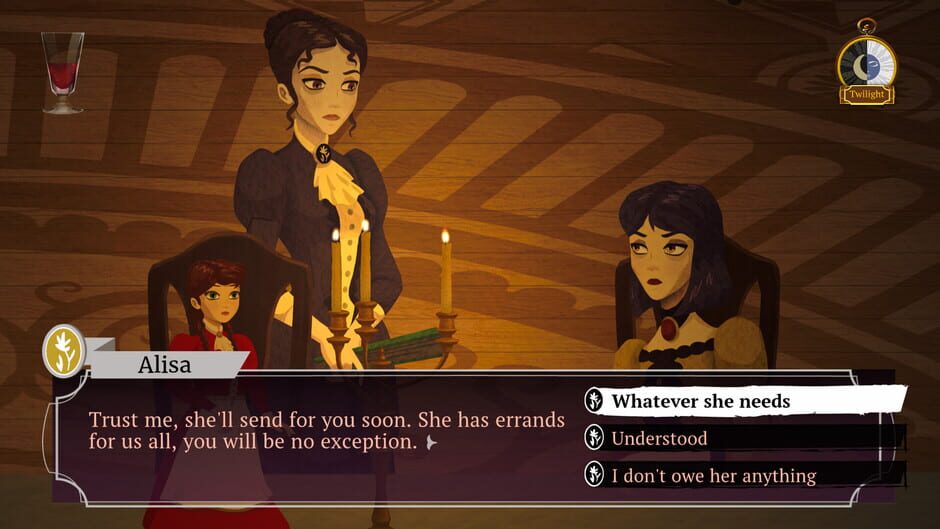
Cabernet is a 2D narrative RPG set in 19th century Eastern Europe. Guide Liza, a young vampire struggling with her morality and the supernatural world she has been pulled into. Beware, the taste of Cabernet is not for the faint of heart - prepare to explore themes of social conflict, alcoholism, and corruption.
Runs well on modern hardware.
Last updated 11h ago
When I first tried this game, I didn't expect how profound (in a very "down-to-earth" kind of way) it would turn out to be. It was funny, it was emotional, it was charming, it was horrifying, it was inspiring. But most importantly for me, it was thought-provoking. It provided me with a new perspective regarding the world, humanity, and the cyclical nature of history. And one of the most important take-aways of mine from this was: even if nothing matters, everyone is ultimately quite stupid and everybody makes the same mistakes over and over, that doesn't mean you're excused to be a heartless sadist. It felt like a "rage against the dying of the light", but in a moral sense. Nothing matters? Cool. I'll go ahead and be a good person anyways. Social and political movements keep arising, just to ultimately tear down everything they were meant to build and everyone they were meant to serve? Here, let me serve you some tea, it's my treat! The rich and powerful keep tearing each other apart with the unwilling hands of the common folk? Come on, let's go on a nocturnal stroll and watch the stars together. This story has taught me the value of appreciating the here and now, and above all: the people you meet. Actual individuals you stumble upon on this long journey called life, and to cherish their company while you can. Because, mortal or not, at the end of the day, that's all that matters.
Cabernet. To be honest, it’s actually a pretty interesting choice for a title, even setting aside the fact that in the game’s lore, this word has its own special meaning. Why? Well, this grape variety is called a “colonizer” because, due to its general accessibility and hardiness, it’s displacing older and more traditional varieties. Isn’t this a kind of wink to players, given that the game is set at the turn of the 19th and 20th centuries - a period of great political and social upheaval? Game itself is a narrative RPG which, rather than combat, places the emphasis on getting to know NPCs, exploring the world and role-playing your character. After the prologue, you are given the freedom to choose, and it is entirely up to player what they wish to do with that freedom. Another important point is that game does not try to pretend that everything can be easily categorized on a ‘good versus evil’ scale; it isn’t, because that’s not how the real world works either. Everyone has their own reasons for their decisions, and it is rarely so difficult in an RPG to determine who is really the villain and who is the monster. Not that everything is perfect, mind you. Game also has its issues stemming from budget constraints, which it manages to cover up more or less successfully. For example: it’s too easy to make money by playing cards and save scumming (which essentially undermines the entire game economy); there are sometimes issues with interactions with certain POIs (95% of the time it works, but that remaining 5% can be really annoying); and, of course, system that only allows manual saving in specific locations. [b]Would I recommend it? Yes [/b] It’s a brilliant RPG that not only offers a great deal of freedom in decision-making but also ensures that the consequences of those decisions are realistic and affect gameplay. Its only major drawback is that interacting with POIs can sometimes be problematic. ✅[list] [*] Graphics can be described as attractive by its simplicity. Locations and backgrounds are cel-shaded while characters uses a paper doll design. [*] Gothic and mournful soundtrack fitting the game’s theme and timeline. It was composed by Jim Fowler & Elena Alekseeva. [*] Fantastic voice acting. Actors are well-suited to the characters they play; you can tell they’ve put a lot of effort and heart into their work. [*] UI is well designed and organized. Tutorial is seamlessly integrated into the game's narrative. [*] Main plot is decent but doesn't blow you away. I’d say that, in the context of vampire intrigues, it might be a bit predictable for some; however, its skillful weaving into human affairs and politics gives it a certain originality. Vampires are, by definition, associated with monsters, but in this game, humans can give them some pretty stiff competition in the battle for that “title.” [*] Game really shines when you move on to the side quests. That's because each one of them is actually centered around a specific person, their flaws, problems, and shortcomings. Game truly captures the complexity of real-life interpersonal relationships and gives the player various options for resolving problems. [*] Worldbuilding. It was done exceptionally well, because the vampires are woven into the story in such a way that at no point did I catch myself thinking: “But that’s illogical.” In addition, story is set in a nameless town somewhere in Eastern Europe. This town serves not only as the setting for the story and the unofficial secondary protagonist but also as an anchor for all these customs and beliefs. It all fits together, and you get the impression that whole thing really makes sense. [*] RPG mechanics are genre’s classics but I like how your choices, skills and friendships/alliances shape the story. Every single one of them counts and matters. [*] While game guides you, it doesn’t handhold nor artificial limit your actions. [*] Morality system that is not based on bland and overused “good – evil” scale. Your choices are in shades of grey; moral decisions might have terrible consequences. [*] Several completely different endings. Aside from the so-called “true ending”, each one is really just a choice between a lesser and a greater evil. [*] You can kill both major and minor NPCs and story will keep going on. [*] A few simple puzzles and mini-games. They offer a pleasant break from the main gameplay, yet aren't difficult enough to discourage player. [*] In-game glossary provides lore about culture, supernatural world and folklore traditions. [*] Price/length ratio is well balanced. [/list] 😐 [list][*]You can use vampiric abilities in free-roam but you’re unable to use them in the quests, unless it was written into the narrative. [*]You can make a manual save only at the designed locations. [*] Every potential card player should have a certain amount of money at their disposal. Currently, it’s too easy to get money by betting everything on all-in and save scumming. [/list] ❌[list] [*] The way interactions with POIs were implemented wasn’t very well thought out. Unfortunately, I often had to figure out exactly which angle to stand at for a given object to display the icon for a specific interaction. This definitely needs to be improved, as it can make the game significantly more difficult during those rare moments when a timer is activated. [*] Walking speed is too slow, sprint isn’t much better. [*] It’s a pity that game doesn’t tell the player at what time or on which days they can find a particular NPC. That would save them from having to wander back and forth unnecessarily. [*] In my opinion. in the middle of the game, main storyline was pushed aside to make room for side quests. [*] Occasional narrative inconsistencies resulting from different choices. [/list]
A hidden gem. Great atmosphere, engaging storytelling, and genuinely enjoyable gameplay.
Reviews sourced from Steam. All reviews belong to their respective authors.
Data sourced from RAWG, Steam, IGDB, CheapShark, Wikipedia, HLTB, and GX Corner. Sources: rawg, steam, igdb.
All game titles, trademarks, and copyrights belong to their respective owners.
