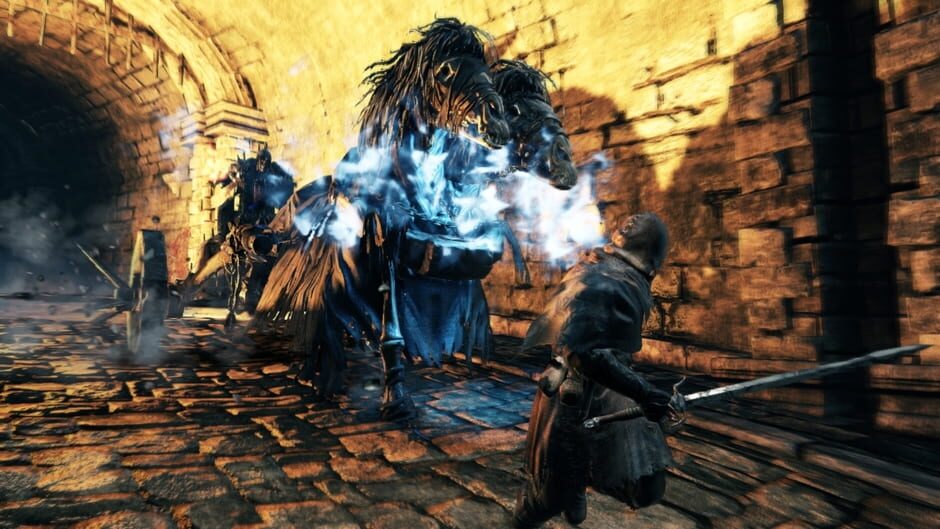
Dark Souls II confidently hits its marks as a quality Action/RPG title.
89
Verdict
88%
Steam
90
IGDB
Verdict score based on confidence-adjusted Steam reviews?
Very Positive Steam reviews (88% positive)
Critically acclaimed (90/100 critic average)
Rich open world to explore
Engaging multiplayer/co-op experience
Steep difficulty curve may not appeal to casual players
Dark Souls II is an action role-playing game developed by FromSoftware and published by Bandai Namco Entertainment, released in March 2014. Set in the kingdom of Drangleic, players control the Bearer of the Curse, seeking to cure their undead curse. The game features challenging combat, deep lore, and a dark, atmospheric world. It introduces new mechanics like dual-wielding and a flexible character progression system, with improved multiplayer options for cooperative and PvP play. The online servers were shut down on March 31st, 2024.
Runs well on modern hardware.
Updated 2h ago
Summary: A better than expected Souls game that laid the foundation for greats like Elden Ring. Combat: Combat is superficially similar to Dark Souls 1, but there are a number of changes that I think turn away DS 1 and 3 enthusiasts, and function very differently from other critically acclaimed Fromsoft games. Firstly, the game has AGL which affects iFrames during rolls and speeds up item usage (like estus and lifegems). This feels like it is a "stat tax", forcing players to invest a set amount into it. Additionally, combat is not frenetic like Bloodborne and physical defense and poise are not good for PvE, meaning that tanking style play from DS1 is no longer viable. Melee combat is very much focused around positioning. Combined, these elements are a negative in my book. Even when locked on to an enemy, you can direct your weapon swings and rolling in ways that you could not in DS1, so that is another change. Lastly, the introduction of a heal over time to estus rather than instant heal makes estus usage in fights riskier. These all make combat feel very different to any other Fromsoft game. There are some good combat changes, such as power stance, durability becoming a meaningful mechanic, several environmental choices affecting boss fights (torches, levers, keys). The game also stays away from hard gimmick fights like the Bed of Chaos from DS1. However, it does include gank fights in general, and these feel more punishing because animation lockout from poise depletion is common. Music: Excellent music for Majula, and overall I thought the music and sound design was much better and thematically appropriate than DS3. Maybe overall not as impactful to me as DS1, but excellent nonetheless. Level Design: This is where the game stands tall above all other DS games. It has vistas, castles, decaying ruins and polished buildings. It utilizes shortcuts, zip lines, boulder traps, multiple entry zones to maps, vertical layering and horizontal sprawl effectively. Players have agency to choose where to start from the hub, just like in DS 1. Enemy placement is the main commplaint: many places have gank squads where the developers tried to overwhelm the player by sheer numbers. Lore: The clearest throughline for lore in this game is to see how time progressed since DS1. It handles this respectfully (unlike DS3, which basically just recasts DS1 in a "greatest hits" style drag and drop). However, the best part of DS2 lore is the original stuff: no other DS NPC has evoked pathos like Lucatiel. No other NPC has encouraged introspection like Aldia. The introduction cutscene of the game artistically communicates far more in its subtle references: to fate weavers, reflection in the water, and the human experience of hollowing in the real world. DS1's cutscene was an info dump, and DS3's cutscene was a lazy cut and paste of Demons' Souls. DS2 shines in its lore and punches way above its weight class here. Conclusion: This game is an excellent prototype for Elden Ring; innovative, experimental, and grand. It failed in some of the most important areas (combat feel and enemy placement), but succeeded in environmental design, artistic vision, and lore. This is a 7/10 for me: on the same tier as DS3 for almost entirely opposite reasons. Where this game failed in combat (and DS3 was the Souls games' crowning achievement), it picked up where DS3 failed in environmental design, lore, and artistic vision. I would definitely play this game again.
It might be better than SOTFS, it feels like there is less ♥♥♥♥♥♥♥♥ ganks in this game. Besides that generally a lot has improved from DS:PTDE, lots of good QOL changes and better menus. DS2 has a little bit of sauce that the others don't quite have, it often has these comedic moments that none of the other games have, but it doesn't feel like they were trying to be funny. All this as well as a couple things like powerstancing and Majula is about all the good I can say. The rest of the game feels like a mediocre 3rd party souls-like. Majority of the areas suck ass, majority of the bosses suck ass, enemy variety is quite bad (although not as bad as Code Vein or Lords of the Fallen). It's really clear why this game is hated, despite that I enjoy it quite a lot, definitely more than majority of souls-likes I've played. 7/10
A solid 7.5/10 from me. It's definitely the worst of the Dark Souls Trilogy, but frankly most of the game is 9/10 quality. It's just some of the stupid mechanics and obnoxious design that drag this game down so much for me. I got rage baited more times in this game than ANY other from software game and I've literally played them all. This is my least favorite single player game from this studio and it's still excellent (for the most part). I don't think this game is "bad" as some suggest, by any stretch. But I understand why it's the fandom's lesser favorite.
Reviews sourced from Steam. All reviews belong to their respective authors.
Data sourced from RAWG, Steam, IGDB, CheapShark, Wikipedia, HLTB, and GX Corner. Sources: rawg, steam, igdb.
All game titles, trademarks, and copyrights belong to their respective owners.
