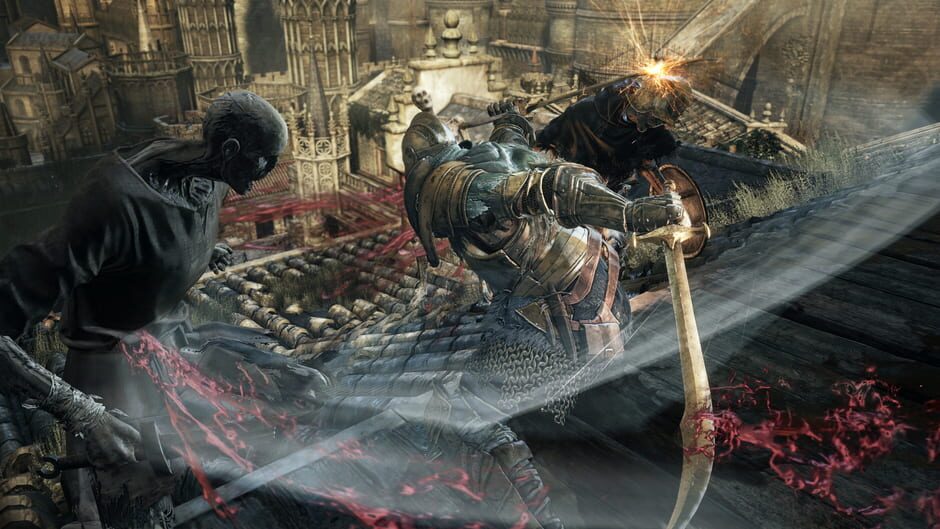
With near-perfect execution, Dark Souls III is a must-play for any action fan.
92
Verdict
94%
Steam
86
IGDB
Verdict score based on confidence-adjusted Steam reviews?
Very Positive on Steam (94% positive from 430K reviews)
Healthy player count of 4,320 concurrent
Critically acclaimed (86/100 critic average)
Compelling narrative and story
Steep difficulty curve may not appeal to casual players
Dark Souls III is a 2016 action role-playing game developed by FromSoftware and published by Bandai Namco Entertainment. Released for the PlayStation 4, Xbox One, and Windows, the game is the third and final entry in the Dark Souls series and follows an unkindled warrior on a quest to prevent the end of the world. It is played in a third-person perspective, and players have access to various weapons, armour, magic, and consumables that they can use to fight their enemies. Hidetaka Miyazaki, the creator of the series, returned to direct the game after handing the development duties of Dark Souls II to others.

Runs well on modern hardware.
Last updated 4d ago
Bruh... its Dark Souls 3. You KNOW its a good game... I will say, I think 3 is a bit harder- in an overall sorta way- as opposed to 1 and 2. Not Sekiro hard, but hard in a fun, challenging way. Buy it!
Why Do We Still Reach for the Fire When It Is Dying? I did not truly understand Dark Souls when I defeated a difficult boss. That understanding arrived slowly, like cold rain sinking into old stone. At first it only felt lonely. Later I realized the loneliness had already settled somewhere much deeper. I completed Dark Souls in October 2025, and Dark Souls II a month later. Two months is not long in ordinary life, yet in the world of Souls it felt enough to watch entire kingdoms fade away. When I first entered Lordran, I believed in the fire almost instinctively. Fire meant roads, cities, memory. It meant human beings could still recognize one another in the dark. Lordran was already ruined, yet there was still dignity inside its ruin. Anor Londo stood beneath its golden illusion like the memory of a civilization that refused to admit it had already died. And Gwyn— The first time I faced him, I expected majesty. Instead I found an exhausted old king beneath mournful piano notes. He no longer felt divine. He felt tired. Like the final person remaining after the end of a long age. That was why I linked the fire in Dark Souls. Not because I trusted the gods, but because the flame still seemed capable of giving meaning to suffering. A bonfire was never merely a checkpoint. It felt human. Temporary. Fragile. Like light seen through snow from the window of a distant house. Then came Dark Souls II. Drangleic did not feel like myth. It felt like erosion. Kingdoms rose and vanished so many times that history itself seemed worn thin. What stayed with me most was not despair, but exhaustion. People no longer asked whether the fire should continue. They asked how many times the same tragedy had already repeated. Lucatiel haunted me more than any king. Her tragedy was painfully small. She did not die gloriously. She forgot herself piece by piece. Her name, her face, the reason she fought—all of it slowly disappeared beneath the curse. That was the first time I began to suspect the fire might not only preserve civilization. Perhaps it also preserved suffering. Even then, I could not fully reject it. Perhaps because I remembered the warmth of bonfires. Perhaps because I had seen Gwyn. Then I entered Dark Souls III. The Cemetery of Ash did not feel like a beginning. It felt like arriving too late. Grey sky, half-open coffins, wind moving through gravestones. The player was no longer the Chosen Undead. The player was ash: something left behind after the burning had already failed. That single idea changes the entire mood of the game. Lothric does not resemble a kingdom waiting to be saved. It resembles the last dust of many dead ages piled together. Dragon corpses hang above the High Wall. Pilgrims crawl toward the castle with bent backs. Knights continue their patrols through empty halls long after the world they protected has vanished. The game quietly tells you: the fire has burned too long. And nowhere is that sadness sharper than in the moments when the past returns. Not triumphantly. Not beautifully. As ruins. The Smouldering Lake is filled with the remains of Izalith. Quelana. The Fair Lady. Names once hidden deep beneath Dark Souls now survive only through corpses and abandoned relics. No cutscene explains their fate. You simply walk into the ruins and understand, all at once, that certain stories ended long before you arrived. That is why it hurts. The Fair Lady was never heroic in the usual sense. She was blind, ill, gentle. She endured pain quietly while others worshipped her without understanding her suffering. In Dark Souls III, she and Quelana seem finally reunited, but only after death. No farewell. No reunion. Only silence. That silence is the soul of Dark Souls III. When I returned to Anor Londo, I stopped moving for a long time. The city was still beautiful beneath Irithyll’s moonlight, but the warmth had disappeared from it. The great stairways remained. The silver knights remained. Yet it felt less like returning home than walking through the preserved body of something ancient. And then there was the Giant Blacksmith. No grand speech. No dramatic ending. Only a corpse where the sound of hammering once echoed through empty halls. That moment hurt more than many boss fights. Perhaps because bosses are meant to die. The blacksmith was not. He belonged to the ordinary rhythm of the journey. You visited him, repaired your weapon, listened to the steady sound of metal striking metal, and left again. In a world full of lies and fading gods, he felt strangely dependable. Returning years later and finding only silence there felt almost unbearable. That is what Dark Souls III understands better than most games: nostalgia is not the return of the past. It is realizing the past continued disappearing without you. The Soul of Cinder carries the same sorrow. It is not a person, but the remains of everyone who once linked the fire. And when Gwyn’s melody returns during the second phase, the entire trilogy suddenly feels impossibly distant. Gwyn is gone. Lordran is gone. The fire itself is fading. Yet something still refuses to let go. After I defeated the Soul of Cinder, I sat in silence for a very long time. The room was dark except for the monitor. The flame still flickered weakly on the screen. I did not feel triumph. I felt as though I had closed the final page of an old book and realized the people inside it were truly gone. That is why the endings matter so much. Linking the fire no longer feels glorious. The flame crawls weakly across the Ashen One’s body like the last light of a dying lamp. The ending of fire is quieter, almost merciful, yet letting the flame die carries its own grief. Even the usurpation ending cannot escape sadness. Every choice feels stained by time. And then there is Gael. At the end of the world, after kingdoms, gods, and histories have all collapsed into ash, one old knight still wanders onward searching for pigment for a painted world. Not glory. Not salvation. Only color for something that does not yet exist. There is something unbearably gentle in that. Looking back now, the trilogy feels less like three games than three stages of farewell. In Dark Souls, I believed in the fire. In Dark Souls II, I began to doubt it. In Dark Souls III, I stood before its dying light and realized doubt had not erased tenderness. For the bonfires. For ruined kingdoms. For Lucatiel slowly forgetting her own name. For the Giant Blacksmith’s hammer falling silent. For the Fair Lady waiting alone beneath the earth. For every small light that tried to survive in a world growing steadily darker. When the fire is about to fade, why do we still reach for it? Perhaps because even after everything else is gone, the hand still remembers warmth.
ive beaten this game at every stage of my life at this point, when it launched, then two years later, then again, and again, its one of few games i return to on a cycle without even really deciding to, i just find myself reinstalling it, and every time its different, not because the game changed but because i did, the first playthrough i was dying to everything, watching boss videos, a couple years later i was clearing the same bosses first or second try and noticing things in the level design i completely missed before, now i run through it like im visiting somewhere familiar, i know every shortcut, every enemy, every item, and i still enjoy every second of it, that's the thing about dark souls 3 that's hard to explain to someone who hasn't played it, the game has layers that dont reveal themselves until you have put serious time in, the world design, the way the lore is buried in item descriptions, the way certain boss fights reframe earlier areas, it rewards you for paying attention across multiple playthroughs not just one. if you've never played it, play it, if you played it years ago and didn't finish it, go back, if you are like me and just finished another playthrough..... yeah, see you again in two years.
Reviews sourced from Steam. All reviews belong to their respective authors.
Data sourced from RAWG, Steam, IGDB, CheapShark, Wikipedia, HLTB, and GX Corner. Sources: rawg, steam, cheapshark, igdb.
All game titles, trademarks, and copyrights belong to their respective owners.