
Death Stranding Director's Cut stands out as one of the best Action/Adventure titles in recent memory.
91
Verdict
92%
Steam
—
IGDB
Verdict score based on confidence-adjusted Steam reviews?
Very Positive on Steam (92% positive from 61K reviews)
Healthy player count of 4,522 concurrent
Compelling narrative and story
Rich open world to explore
Limited professional critic coverage
Death Stranding is a 2019 action-adventure game developed by Kojima Productions and published by Sony Interactive Entertainment. It is the first game from director Hideo Kojima and Kojima Productions after their split from Konami in 2015. It was first released for PlayStation 4 in November 2019, followed by a Windows port in July 2020. A director's cut was released for PlayStation 5 in September 2021, followed by releases for Windows in March 2022, iOS, iPadOS and macOS in January 2024, and Amazon Luna and Xbox Series X/S in November 2024. Sony published the game on their consoles, while 505 Games published all other versions under license from Kojima Productions.
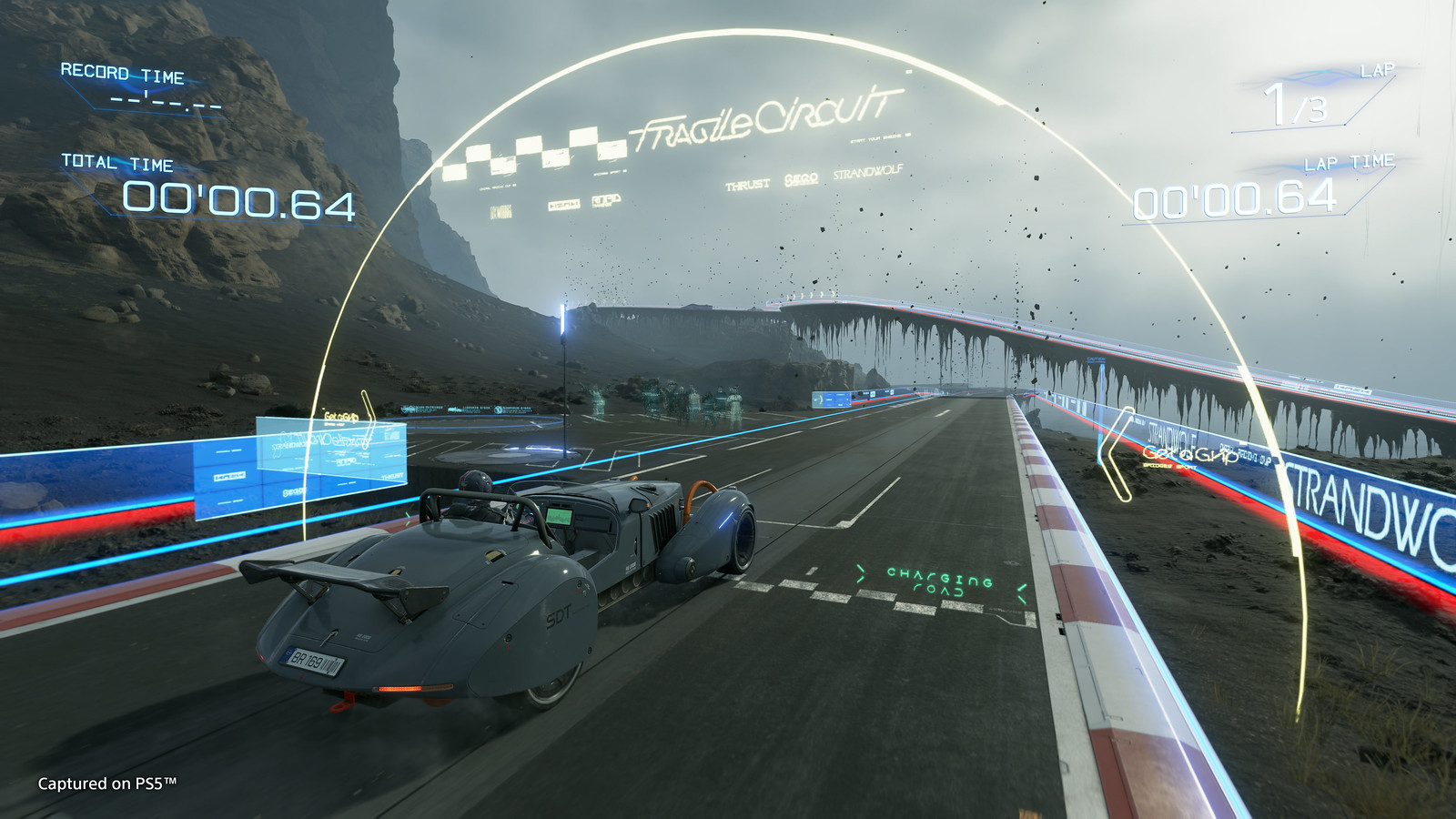
Runs well on modern hardware.
Last updated 3d ago
Death Stranding is not just a game. It's a long, quiet journey that slowly grows on you until one day you realize it never really let you go. When I first started it, I wasn't sure what to expect. You play as Sam Porter Bridges, a delivery man in a broken world. Cities are cut off from each other. People live alone, hidden away, stranded. The land itself feels empty, wounded and dangerous. Your job sounds simple: carry cargo from one place to another. Walk. Don't fall. Don't lose the packages. But somehow, that simple idea turns into something much bigger. This is a game about walking. About distance. About silence. At first, it feels slow. You look at the map and think, "That's far." And it is. If you rush, you fall. If you fall, your cargo gets damaged. So you slow down and keep walking. The world itself is beautiful in a quiet, lonely way. Wide landscapes, green hills, cold rivers. It feels empty, but not dead. And then you finally see your destination far away. In that moment, something clicks. You're not just walking. You're connecting a broken world, one step at a time. It becomes meditative. Almost therapeutic. A game where simply walking forward feels meaningful. And then there's BB. At first, BB feels like just another tool, some weird baby in a jar. Something you carry because you have to. But slowly, without even noticing, that changes. You start checking on BB after every fall. You calm BB down when things get dangerous. You feel guilty when BB gets stressed. That tiny pod hanging on your chest becomes more than equipment. In a world that feels empty and cold, BB becomes warmth. A quiet presence. A reminder that you're never truly alone. And then you build roads, bridges, shelters for other players. You never see them, but you feel connected. You see their signs, their structures, their small messages. A ladder placed in the perfect spot. A rope exactly where you needed it. A sign that simply says "Keep on keeping on". It's a brilliant kind of multiplayer. Quiet. Supportive. Altruistic. This is a game about connection. About hope. About purpose. Sam himself is not a typical hero. He's tired. He doesn't want to be close to people. He avoids touch. But step by step, delivery by delivery, you both change. By the end, you feel like you've been through something together. With him and BB. It's not just BB anymore. It's your BB. In the beginning, the game feels slow. But the further you go, the more things start happening and the faster the story unfolds. In the last few chapters, you won't even think about pausing or going to bed to continue the game tomorrow. You just can't. By the time the credits roll, you don't just feel like you finished a game. You feel like you completed a journey. Like you carried something fragile across a broken world and managed to keep it safe. And somehow, in the process, it carried you too.
Finally, I felt like a courier myself. 👍 Excellent simulator, and so many shoes were worn out. It might seem like just a delivery simulator, but the game turned out to be quite interesting; it immerses you in the atmosphere of post-apocalypse and loneliness, and the music complements it all well. (Pity that you can't turn on the music as you progress and choose tracks.) Of course, you're not alone; there's Lou with you, who sometimes breaks the silence with his laughter and a couple of likes. The game itself raises important themes about how we isolate ourselves and choose our comfort zones far away from others (of course, this might not be as relevant now as during the epidemic, but it is still important). Reflections on what awaits a person after death are always interesting to hear someone's thoughts on the matter, and here is a whole game dedicated to this, so it's interesting to read every message and diary entry. Overall, the game leaves warm emotions, provides food for thought, and perhaps you will find something for yourself too. https://steamcommunity.com/sharedfiles/filedetails/?id=3702299325
Death Stranding is one of the strangest games I’ve ever played, because I genuinely cannot decide whether it is an ambitious masterpiece trapped inside a boring game, or a boring game trapped inside an ambitious masterpiece. There is undeniably something fascinating about it at first. The atmosphere is phenomenal, the music is nothing short of spectacular, and the world feels almost hypnotic during those first hours. Kojima clearly wanted to make something “important,” something larger than the usual AAA formula, and for a while I was completely on board with it. The traversal mechanics especially caught my attention. The idea that the journey itself becomes the adventure instead of merely existing between action sequences is honestly refreshing. Then the game asks you to do it again. And again. And again. And again. Eventually, the illusion starts to collapse. Nearly every mission feels functionally identical: carry object from Point A to Point B with little to no variance. No stealth, infiltration, sabotage, round-up missions, meaning the game is the equivalent of Final Fantasy XV's worst design: fetch quests, but an entire game. New gadgets and mechanics arrive later, but not nearly fast enough to justify how repetitive the experience becomes early on. By the time the game “opens up,” I was mostly wondering whether the destination was worth the hike. Kojima already had this issue in Metal Gear Solid V, another game where brilliant systems were stretched across an experience that somehow felt endless, repetitive, empty and frankly boring at the same time. The real disappointment, though, is the story. The opening hours create a genuinely fantastic premise filled with mystery and tension, but the narrative quickly disappears into an avalanche of nonsense terminology and self-serious exposition. Characters constantly talk about chirality, DOOMS, Beaches, BTs, BBs, extinction entities, and whatever new word Kojima throws at you. The game desperately wants all of this to sound profound, but after enough cutscenes it starts feeling like listening to someone blabbering after smoking weed. The dialogue certainly does not help. Half the cast speaks in exposition dumps, while the other half communicates through awkward puns and lines that sound like they were translated into English by someone who learned human interaction exclusively through Wikipedia articles. Every conversation feels one step away from someone turning directly toward the camera and saying, “Perhaps the real Death Stranding was the strands we stranded along the way.” Absolutely ridiculous. And yet, despite all of this, I cannot completely hate the game. There is something unique here. I can understand why some players connect deeply with its slow, meditative rhythm. Kojima was clearly trying to create something genuine and unconventional instead of another safe blockbuster product assembled in a corporate laboratory. But for me, the experience never evolved enough. I kept waiting for the game to surprise me, to deepen mechanically, narratively, emotionally — to finally deliver the punch its atmosphere kept promising. After around 12 hours, that moment never came. It's hard to recommend this game to someone who likes video games for the sake of interaction. As an adventure game, I still think Journey is a far superior walking simulator, and it's going to be hard to match it. However, if you don't take mechanics too seriously, and are on board of delivering the same quest a million times, then the game might be for you. In the end, I respect Death Stranding for what it is more than I actually enjoy it. And honestly, that may be the most Kojima sentence imaginable. But ultimately, I feel the game is stranded between the beach of a masterpiece, and the beach of a bad game, never fully reaching either of them.
Reviews sourced from Steam. All reviews belong to their respective authors.
Data sourced from RAWG, Steam, IGDB, CheapShark, Wikipedia, HLTB, and GX Corner. Sources: rawg, steam, wikipedia.
All game titles, trademarks, and copyrights belong to their respective owners.