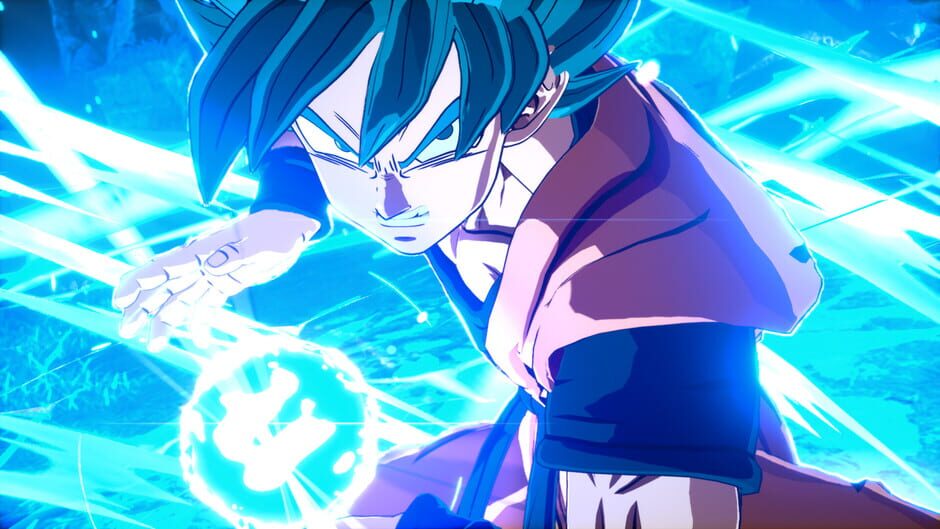
DRAGON BALL: Sparking! ZERO is a strong Action/Fighting that delivers where it counts.
86
Verdict
88%
Steam
83
IGDB
Verdict score based on confidence-adjusted Steam reviews?
Very Positive Steam reviews (88% positive)
Healthy player count of 888 concurrent
Critically acclaimed (83/100 critic average)
Rich open world to explore
No significant drawbacks reported
Dragon Ball: Sparking! Zero takes the legendary gameplay of the Budokai Tenkaichi series and raises it to whole new levels. Make yours the destructive power of the strongest fighters ever to appear in Dragon Ball!

Runs well on modern hardware.
Last updated 1d ago
what the ♥♥♥♥ did i pay 110€ for this half-baked game for, now my ultimate edition is delisted and i don't even have the new DLC that had to be free after the ♥♥♥♥ lunch this game had, you now want me to pay an extra 35€ for cut contents of this game because you couldn't finish it before release? yeah, now the price is 50€ instead of 70€, nice scam, i'll crack the game with all the DLC and the new mode that NEEDED TO BE FREE beacause the singleplayer experience is pure A S S. Never preordering a bandai game ever again, greedy ass company, couldn't even add some anime emotes, only used 3 animations for every characters using Unreal's retargeting. Over 200 characters my ass, 50 Gokus and 50 Vegetas
Feels like we're being punished for buying the game early considering I spent 100$ on the ultimate edition and now the legendary edition is 90$ with neo. So if I buy the dlc thats 135$ vs I could have waited and got it all for 90$ Kina bs.
As someone who has played a ton of Dragon Ball games, bought plenty of season passes, and genuinely loves this franchise, the way DRAGON BALL: Sparking! ZERO is being monetized feels increasingly predatory. The base game costs $69.99. The Deluxe Edition costs $99.99. The Ultimate Edition costs $109.99. The Season Pass costs $34.99 separately. I bought the Deluxe Edition because it included the Season Pass. Paying nearly $100 upfront reasonably suggested that I was buying the game together with its meaningful post-launch content—not temporary access to the first few packs before being charged again for the expansion that actually resembles a major expansion. Instead, the Season Pass was filled out with content including Shallot, the protagonist of a mobile game, while Super Limit-Breaking NEO is being separated from it and sold as another DLC. This is not a minor costume pack. Bandai Namco advertises 33 playable characters, a new solo mode, four Episode Battles, additional Extra Battles, and four stages. Even “33 characters” needs context but transformations are counted as separate roster entries: Vegeta (GT) and Super Saiyan Vegeta (GT) count separately, as do Trunks (GT) and Super Saiyan Trunks (GT), while Super Saiyan Bardock is another entry rather than a transformation for the Bardock already in the game. So this is not 33 distinct characters. Many of the actual characters are not new to Budokai Tenkaichi either. Grandpa Gohan, Mercenary Tao, Demon King Piccolo, Zangya, Pikkon, Super 17, Nam, Android 8, General Blue, Fasha, Salza, Supreme Kai, Uub, King Vegeta, and Nuova Shenron were already playable in Budokai Tenkaichi 3. Yes, recreating them for a modern engine required models, animations, effects, balancing, voice work, and development time. The problem is the product structure: established characters from the previous major game were omitted from the $70 successor, excluded from the $35 Season Pass, and reserved for another paid expansion after Deluxe and Ultimate Edition customers had already paid $100–$110. I understand the technical defense that the Season Pass listed four specific packs and did not promise every DLC forever. But that does not erase the expectation created by selling premium editions around something literally called a Season Pass especially when the largest post-launch expansion is excluded. The pass was not communicated cleanly either. On June 23, 2025, the official Steam description was changed to say it included “34 DLC Packs.” On September 24, it was changed to “4 DLC Packs.” It was probably a typo, but the official sales page displayed it for roughly three months. Customers should not have to reverse-engineer what the publisher intended its own product description to say. I remember when a new game cost $60 and generally felt complete. Now the entry price is $70, premium editions cost $100–$110, and major content is still carved out and sold separately. Bandai Namco reported 5.4 million copies sold by the end of March 2025. At the full $69.99 list price, that represents roughly $377.9 million in gross retail value. That is not the company’s actual revenue or profit: copies were sold across several platforms, at different prices, and taxes, refunds, development, marketing, licensing, distribution, and storefront fees all matter. But the scale is still enormous. Steam takes 30% of the first $10 million, 25% between $10 million and $50 million, and 20% above $50 million. In a purely illustrative all-Steam, full-price scenario, Steam would receive about $78.6 million and roughly $299.4 million would remain on the publisher side before other expenses. Now suppose this DLC costs $29.99. At only 10% adoption among 5.4 million owners, that is $16.2 million gross and about $12.96 million remaining after a 20% Steam share. At 25%, it is $40.5 million gross and about $32.4 million remaining. At 50%, it is $81 million gross and about $64.8 million remaining. Again, those are illustrations, not profit estimates. The point is that even a modest purchase rate generates millions more from customers who may already have paid $100 or $110. At $29.99, a Deluxe Edition buyer would be at about $129.98 and an Ultimate Edition buyer at about $139.98, before the two $14.99 anime music packs and other extras. I am not arguing that developers should work for free or that every expansion must be included forever. I am arguing that customers who paid extra specifically for a Season Pass should not feel they bought the wrong premium edition when the largest expansion arrives. At minimum, Season Pass, Deluxe Edition, and Ultimate Edition owners should receive Super Limit-Breaking NEO at a substantial discount or a reasonably priced upgrade path. Ideally, it should be included for those customers as recognition that they already paid a premium for the game and its post-launch content. Dividing one game into a $70 base product, $100–$110 premium editions, a separate Season Pass, music packs, small character packs, and then another major expansion is not rewarding loyal fans. It is testing how many times those fans can be charged for the same game before they finally stop paying.
Reviews sourced from Steam. All reviews belong to their respective authors.
Data sourced from RAWG, Steam, IGDB, CheapShark, Wikipedia, HLTB, and GX Corner. Sources: rawg, steam, cheapshark, igdb.
All game titles, trademarks, and copyrights belong to their respective owners.