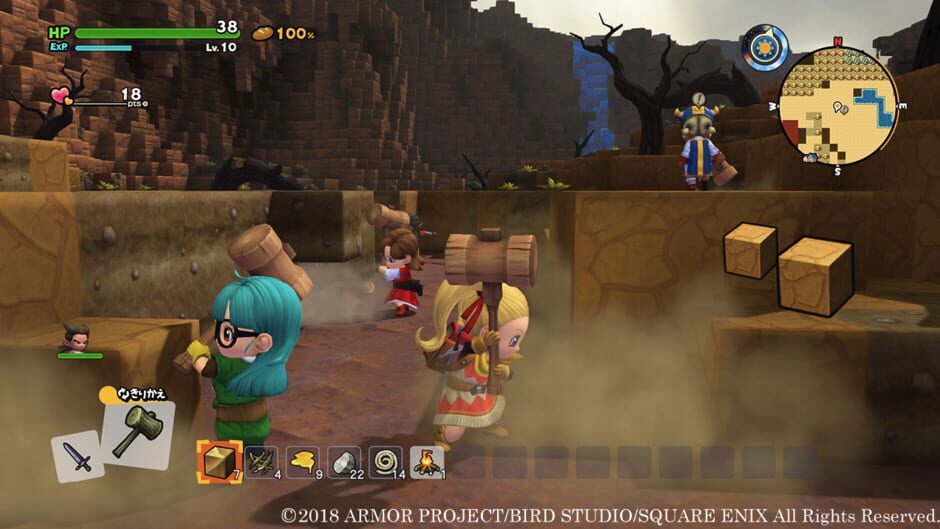
A masterclass in action design, Dragon Quest Builders 2 delivers an unforgettable experience from start to finish.
90
Verdict
92%
Steam
85
IGDB
Verdict score based on confidence-adjusted Steam reviews?
Very Positive on Steam (92% positive from 7.8K reviews)
Healthy player count of 802 concurrent
Critically acclaimed (85/100 critic average)
Engaging multiplayer/co-op experience
No significant drawbacks reported
Dragon Quest Builders 2 is an action role-playing sandbox game co-developed by Square Enix and Koei Tecmo's Omega Force and published by Square Enix. The sequel to Dragon Quest Builders, it was released for the Nintendo Switch and PlayStation 4 in Japan in December 2018 and worldwide in July 2019, for Windows in December 2019, and for the Xbox One in May 2021. The game shipped over a million copies by August 2019 and received generally favorable reviews from critics.

Runs well on modern hardware.
Last updated 7d ago
[b] Gameplay: [/b] 9.2/10 ; [b] Story: [/b] 7.8/10 If the first game could be described as [b] "Minecraft with a classic Dragon Quest flavor," [/b] then [i] Builders 2 [/i] feels more like [b] "Minecraft meets Story of Seasons and Terraria." [/b] Likewise, if the original was about [b] a lone hero rebuilding the world [/b], this sequel is about [b] everyone working together to make it happen [/b]. Let's start with the gameplay. Purely from a gameplay perspective, there's no question that [i] Builders 2 [/i] is richer and deeper than its predecessor. It expands nearly every system, adds significantly more content, and smooths out many of the awkward mechanics and quality-of-life issues from the first game, making the overall experience much more enjoyable. What I appreciate most, though, is the incredible sense of everyday life and exploration the game creates. Combined with this installment's unique mechanics, it genuinely feels like you're living in this world rather than simply playing through it, and that feeling is wonderfully relaxing. That said, the PC version still has room for improvement in terms of optimization. The frame rate is capped at 60 FPS, and loading times can be fairly long. Ironically, the PC port of the first game, released in 2024, actually performs noticeably better overall. The interface also retains a few lingering quality-of-life issues. Inventory management and item sorting could have been handled much better. Once your storage starts filling up in the late game, tracking down a specific item can become surprisingly tedious. Now let's move on to the story. Without spoiling any major plot points, I'd like to compare the two games based on their overall narrative structure and thematic focus. Personally, I still prefer the first game's story and central theme. If I had to sum it up in one sentence, it'd be: "[b] Even if you're not the chosen hero, you still have the freedom to choose your own path. [/b]" That idea remains consistent throughout the entire game. Rather than obsessing over grand destinies or legendary prophecies, the protagonist values the small bonds formed between ordinary people—and in the end, it's precisely those seemingly insignificant connections that make saving the world possible. In many ways, it stands apart from the grand heroic narrative traditionally associated with the mainline [i] Dragon Quest [/i] series, and that's something I deeply appreciate. Its chapter-based structure reinforces this central theme exceptionally well. Across four major chapters, each one builds upon the same idea before everything comes together in a satisfying and emotionally resonant finale. Now, back to [i] Builders 2 [/i]. On the surface, this game tells a more continuous and linear story, but structurally it's still divided into four major chapters. Each chapter centers on a new large island, with transitional events—such as the prison escape sequence—bridging them together more naturally. If I had to summarize this game's thematic focus, I'd break it down into three main ideas: [b] 1. [/b] The relationship between the protagonist and Malroth (the primary theme that runs through the entire game) [b] 2. [/b] Cooperation between people (secondary) [b] 3. [/b] The philosophical relationship between destruction and creation (tertiary) The first theme is unquestionably the heart of the game—it's right there in the subtitle. While some of the writing relies on familiar tropes commonly found in Japanese anime and games, it's executed well enough to rise comfortably above average. The final chapter, in particular, brilliantly pays off all the emotional buildup accumulated throughout the journey, delivering by far the strongest and most memorable moments in the entire game. Judging that section alone, I'd probably rate the story around [b] 9.5/10 [/b]. The problem is that Chapters Two and Three feel considerably weaker. In my opinion, neither comes close to matching the quality of the opening chapter or the finale. Chapter Three is especially problematic. It introduces emotional tension between the protagonist and Malroth, but before that conflict is properly resolved, the story quickly transitions into the final chapter. Worse yet, for much of the early and middle portions of that chapter, you're separated from him and forced to travel alone. That gap weakens the emotional continuity. By the time the finale arrives, the eventual payoff doesn't land as powerfully as it could have. Since Chapter Three revolves almost entirely around warfare, I actually found my own emotional attachment to Malroth diminishing during that portion of the game—and even the outstanding finale couldn't fully rebuild that connection. This imbalance becomes even more noticeable after finishing the game and looking back at the story as a whole. Once the emotional high of the ending fades, the uneven pacing stands out more and more. There's also a broader issue with the game's narrative approach. Whenever a story chooses to place its primary thematic weight on the relationship between the protagonist and another character, it inevitably risks weakening its other themes. If that central relationship isn't compelling enough to support the entire narrative, the whole story starts to feel hollow. Fortunately, [i] Builders 2 [/i] avoids that pitfall. The relationship between the protagonist and Malroth is strong enough to carry the game. Still, in my view, the other two themes inevitably receive less attention as a result. That brings us to the second theme: cooperation. The first game already explored this idea exceptionally well, and [i] Builders 2 [/i] expands on it further. Interestingly, though, I found the relationships between humans and monsters far more moving than those between humans themselves. The moments that genuinely entertained and emotionally resonated with me almost always involved the wonderfully diverse cast of monsters. Compared to them, many of the human characters simply felt less memorable. Finally, there's the philosophical contrast between destruction and creation. The game certainly presents this idea, but only at a relatively surface level. Most of it is conveyed through dialogue and plot rather than being deeply explored through gameplay or storytelling. While the relationship between the protagonist and Malroth also reflects this theme, the execution doesn't quite go far enough. Ironically, what should arguably have been the game's central philosophical idea ends up feeling more like a supporting theme. Overall, I actually find it difficult to reduce [i] Builders 2 [/i] to a single defining message. That can be viewed as both a weakness and a strength. On one hand, the game lacks the kind of singular, unforgettable core theme that immediately defines the experience. On the other hand, the combination of several overlapping themes gives different players different emotional takeaways, ultimately making the experience richer in its own way. Finally, two important tips: [b] First [/b], if you're planning to earn every achievement like I did, start working on the rarest achievement as early as possible. It revolves around breeding animals and is somewhat reminiscent of raising Chocobos in the original [i] Final Fantasy VII [/i]. It's incredibly time-consuming, and if you leave it until the very end, you could easily spend another 10–20 hours doing little more than waiting. [b] Second [/b], I highly recommend playing the first [i] Dragon Quest Builders [/i] if you haven't already. Both games excel in different ways and each has its own unique strengths. Playing both also makes it much easier to appreciate how differently they approach similar ideas. That said, I wouldn't recommend playing them back-to-back. Their gameplay loops are quite similar, and burnout is a real possibility. Give yourself some time between the two. Thanks for reading, and happy building!
100 Hour Edit: Replayed it again to the end on Steam, and I can still recommend this, but will note that it wastes your time (especially with the explorer's isles checklists) in ways that Builders 1 does not. The main story is better than I remember it, and is worth going through for that aspect alone, even if you're "meh" about building so long as you don't dislike building. Guides on Steam and Gamefaqs along with Neoseeker have very helpful resources on this game, if you don't mind spoilers. At the very least, I recommend looking at them when you're done with the game for the secret endgame weapon. I still like the 2024 revamp of Builders 1 better overall, and recommend playing it first if you know you'll play both games and want to do them in order. There's some references to characters and events in the first game in this second one too. ----------------------- Original Review: I finished this game over two months on Xbox Game Pass, and realized it's a game that's not only worth replaying, but can even be a "forever game" if you enjoy the building aspect. I have 9.4 hours logged so far on Steam, but probably more like 80+ hours on Xbox Game Pass. It's honestly a bit clunkier in some QoL aspects than Steam's version of Builders 1 (which ironically is a NEWER release on Steam, which had the Builders Engine upgraded by Artdink to be more smooth playing) but still more advanced in other ways than Builders 1. If you like Minecraft style voxel building, but want a deep story with lots of goals, this game might be for you. It has its flaws, like going on too long in certain areas, the dreaded text cutscenes that force you to wait a looong time with no way to speed up or skip the text, and having to wait for a music cue everytime somebody joins, but these things are thankfully rare enough not to spoil the majority of the game. I'd say it's worth it on sale, but not at full price for many. If you're not sure, try the Jumbo Demo, which lets you try out most of the first area. The real version of the game has 3 save slots by the way, and the ability to customize your character after creation. The demo is an older patch version too, with fewer tutorials and not as much new stuff, although to be fair, most of that can't be seen in the short slice you get to play. All in all, I like Builders 1 better overall (especially its story and characters), but Builders 2 has a lot more content, including more building options. As I said, if you're not sure, try the demo and wait for sales.
I enjoy this game so much as a narratively focused RPG that scratches my creative itch in the best way. Does it have some flaws? Absolutely, but I think the game design, story, and overall charm of this game outweigh them in such a powerful fashion that I've replayed the game an extra 2 times despite them. (I have 200+ hours on console) If you're on the fence, try the demo. If you think the price is steep, wishlist it and wait for a sale. It frequently goes on sale, usually around 50% off. I literally cannot recommend this game any harder if i tried without petitioning Steam to let me super-recommend it or something.
Reviews sourced from Steam. All reviews belong to their respective authors.
Data sourced from RAWG, Steam, IGDB, CheapShark, Wikipedia, HLTB, and GX Corner. Sources: rawg, steam, cheapshark, igdb, wikipedia.
All game titles, trademarks, and copyrights belong to their respective owners.