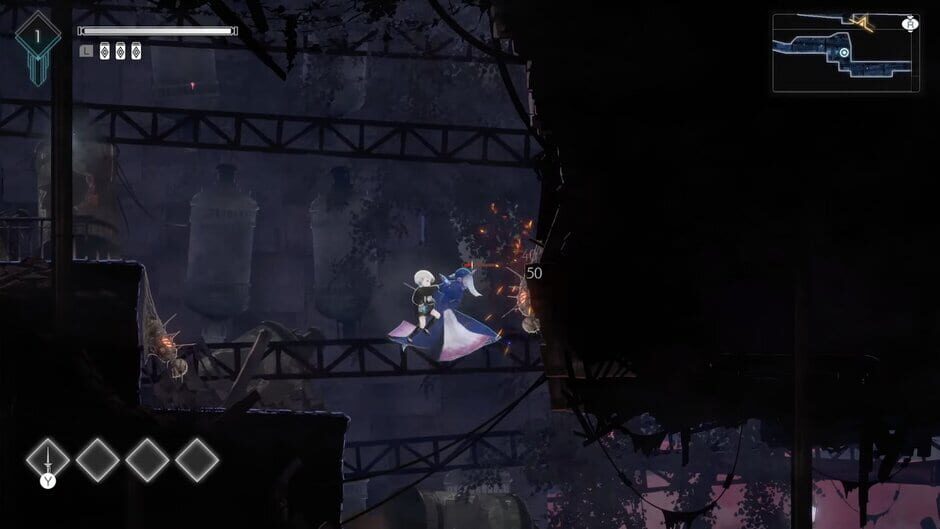
Ender Magnolia: Bloom in the Mist stands out as one of the best Action/RPG titles in recent memory.
93
Verdict
95%
Steam
90
IGDB
Verdict score based on confidence-adjusted Steam reviews?
Overwhelmingly Positive on Steam (95% positive from 17K reviews)
Critically acclaimed (90/100 critic average)
Steep difficulty curve may not appeal to casual players
Still in Early Access — content may be incomplete
Ender Magnolia: Bloom in the Mist is a 2025 Metroidvania video game developed by Adglobe and Live Wire and published by Binary Haze Interactive. It was released in early access for Microsoft Windows on March 25, 2024. Ender Magnolia is a sequel to the developers' previous game Ender Lilies: Quietus of the Knights, set in the same world. In Ender Magnolia the protagonist Lilac goes on a quest to purify the corrupted Homunculi that have overrun the kingdom.

Runs well on modern hardware.
Last updated 3d ago
Amazing, absolutely amazing. Ender Magnolia is the sequel to Ender Lilies, and it vastly improves on everything. Apart from the gameplay and other features, music is what keeps a game alive in your heart for a long time. And the music in this game is truly amazing. The music in each area is unique and perfectly matches the area. Whether you're working or doing something else, you can keep those music playing. It's beautiful. - I really liked the map in this game though because of how it changes the color of the area when you fully explore it. It is a big help in knowing which areas to backtrack to after you progress a lot. - It also shows you if you've collected everything or not in an area with a neat badge next to the name of the area! - There is an option to alter difficulty which is really helpful. - You Can easily access check point & fast travel from anywhere .
A sequel to Ender Lilies being a thing was quite the surprise to me after I finished that game while liking it a lot, so my excitement going into Ender Magnolia being high was not very surprising. So, did it meet my expectations or not? Well, it's actually a little complicated. In many ways, this is a perfect sequel to Ender Lilies. A beautiful story, interesting characters accompanied by cool designs and atmosphere plus a cleaner artstyle and sprites are all very good things. Unfortunately Ender Magnolia also amplified the issue that was somewhat prevelent in Ender Lilies. The game feels quite smoother than Ender Lilies, with the caveat of this only really being the case outside of combat. I have rarely played a Metroidvania that has felt as clunky as this game has at times. Water passages are more annoying than most things in this game, and there being important things (I am being vague to avoid spoilers) in said passages irritated me more than once. The bossfights in Ender Magnolia are for the most part pretty easy and fun to play. But for every fun boss, there is ocassionally another that is just an absolute drag due to it either having way too much HP, totally RNG reliant patterns where memorizing/practicing anything just falls out of the equation or aforementioned clunkyness of the main character just screwing you over hard at random points in the game. Do not get me wrong, I very much like this game and I think it even surpasses Ender Lilies in some aspects. But to have all these great and nice things soured a little by a general clunkyness of the playable character and poor enemy design at times just kind of hurt at times. Still absolutely worth the 25€ though, a steal for such a good game.
Ender Magnolia starts slow. For quite a while it feels like a game that plays things a little too safe. The early hours are easy and boss fights feel more like extended tutorials than real challenges. Coming straight from something like Hollow Knight makes the contrast even stronger. But the interesting part is that the game steadily improves as you progress. Systems open up, difficulty increases, and the story begins to reveal its strength. What initially feels like a pleasant but forgettable Metroidvania slowly turns into something much more engaging. Movement and combat feel good from the start. Controls are responsive, abilities trigger reliably, and dashing works exactly when you need it to. Even though the game has a slower pace overall, it never feels clunky or unresponsive. Exploration follows a traditional Metroidvania structure. You unlock abilities that allow access to previously unreachable areas, so backtracking becomes an important part of progression. The map does a very good job showing where something is still missing, which makes completion far less frustrating than in many other games. If you're going for platinum, you will still need to search for secrets, but the map usually narrows the search to a specific region instead of the entire world. The biggest gameplay strength appears in the build systems. You unlock companions throughout the game, each with multiple possible abilities, but you can only equip four at a time. This forces meaningful decisions once your roster grows. Early on it feels like almost anything works, but after the midpoint you tend to settle into a preferred team. Some companions clearly fit certain playstyles better than others. One ranged companion in particular feels slightly overpowered for a large part of the game thanks to fast attacks, auto-aim and strong break damage, although a late-game companion can rival it. The relic system is another highlight and arguably one area where the game improves over Hollow Knight’s charm system. Relics consume slots but the game gives you far more capacity to experiment with combinations. Some relics become extremely powerful in the late game. Difficulty also changes noticeably after the midpoint. The early game is very forgiving, but enemies and bosses become much more demanding later. By the end of the game the challenge finally feels appropriate for the systems you've unlocked. The story turns out to be one of the strongest parts of the experience. It becomes increasingly engaging as the plot unfolds, and by the final chapters it’s easy to get invested in what’s happening. The final boss serves as a fitting climax. Both endings conclude the story well, although Ending B provides the more satisfying resolution and a significantly harder version of the final fight. One weaker aspect is the soundtrack. While it fits the tone of the game, it rarely stands out. Much of it feels like background lo-fi music rather than something deeply tied to what’s happening on screen. It works, but it rarely elevates the moment. In terms of length, the game lands in a good spot. I took about 25 hours to 100% it, and while a few areas feel slightly longer than necessary, the overall pacing works well. Importantly, the game allows you to obtain both endings and complete all objectives without using any outside guides, which is big plus. TL;DR; I started this game feeling somewhat underwhelmed. But by the time the (second) credits rolled, it was seriously competing for a place in my Top 10. When a game manages to deliver strong gameplay systems, an engaging story, and a well-rounded overall experience, it’s hard not to appreciate what it accomplishes. 8/10
Reviews sourced from Steam. All reviews belong to their respective authors.
Data sourced from RAWG, Steam, IGDB, CheapShark, Wikipedia, HLTB, and GX Corner. Sources: rawg, steam, cheapshark, igdb, wikipedia.
All game titles, trademarks, and copyrights belong to their respective owners.