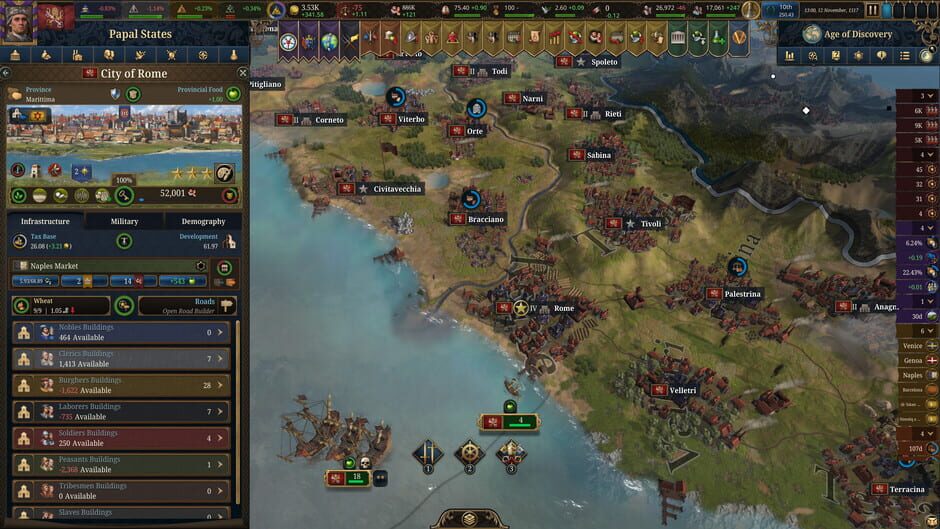
Fans of the strategy genre will find plenty to enjoy in Europa Universalis V.
79
Verdict
72%
Steam
91
IGDB
Verdict score based on confidence-adjusted Steam reviews?
Active community with 7,524 concurrent players
Critically acclaimed (91/100 critic average)
Engaging multiplayer/co-op experience
No significant drawbacks reported
Europa Universalis V is a grand strategy game developed by Paradox Tinto and published by Paradox Interactive. It is the sequel to the 2013 game Europa Universalis IV.
Runs well on modern hardware.
Updated 7h ago
Recommended only if you accept being part of the long Paradox development cycle. I want to be fair to Paradox: Europa Universalis V is not a lazy game. It is not empty. It is not without care. The work is visible. The ambition is visible. The historical appetite is visible. Population, economy, state-building, map scale, slower pacing, alternate history, logistics, diplomacy, internal politics — all of it points toward the kind of grand strategy game I want to exist. That is why this review is difficult. I do not dislike EU5 because it lacks vision. I love the vision. The more alive the simulation becomes, the more I want to believe in it. I want the world to feel material. I want population to matter. I want economy to have weight. I want the map to resist me. I want history to feel like pressure, not just decoration. I want alternate history to emerge from systems, not from shallow fantasy. I even miss custom nations, because in a game like this, authorship matters. I do not only want to consume history; I want to create my own impossible historical machine inside it. But effort is not the same as stewardship. EU5 currently feels like a game whose vision is larger than the structure carrying it. Either the team needs more capacity, or the management structure needs to be better, or the development rhythm needs to become more disciplined. From the player’s side, the result is tiring: I bought a game I increasingly cannot enjoy until a truly stable patch exists. That is the central wound. I am not blind enough, or indifferent enough, to ignore how and why things work or do not work. EU5 asks me to understand its systems deeply, but the more deeply I understand them, the more obvious the cracks become. Its incompleteness is not hidden by complexity; it is exposed by complexity. When EU5 works, it feels alive. When it does not, it feels like labor. Not the meaningful labor of building a state through centuries, but administrative fatigue: waiting for performance to stabilize, wondering whether a patch has changed the rules too much, restarting campaigns, reading around bugs, deciding whether the current version is finally safe enough to invest another dozens of hours into. That is not just inconvenience. In a game this long and dense, instability becomes a tax on attention. And people’s attention matters. A grand strategy campaign is not a disposable match. It is study, imagination, planning, patience, failed starts, system knowledge, emotional investment, and long-form trust. If a game asks for that much of the player, then stability is not a luxury. Performance is not a luxury. Campaign continuity is not a luxury. Clarity is not a luxury. These are the minimum conditions for asking the player to give the game their time. This is why EU5 is not just sold as a game; it is sold as a future, and that future must earn the player’s time before it asks for the player’s money. I am not against DLC. I am not against long development cycles. I understand the Paradox model. I know the bells. I hear the rhythm. These games often become themselves over years. But knowing the process does not make the process less tiring. It does not make the early instability harmless. It does not make the player’s time less valuable. The first DLC captures the contradiction perfectly. I want more flavor. I want Byzantium. I want regional mechanics, alternate paths, historical texture, new systems, new events, more living detail. In that sense, the DLC is acceptable. But paid expansion content feels very different when the base experience still needs stabilization. Then it becomes both acceptable and insulting at once: acceptable as content, insulting as timing. That is where the suspicion enters. Is this ambition, or is it also a taste for capital? I cannot prove motive. I can only judge the structure and the result. And the structure asks the player to buy into a future while the present still feels insufficiently whole. The result is that love turns into fatigue. The game’s own greatness makes its pitfall more painful, because I can see what it wants to be, and I can also feel how much of that promise still lands on my patience rather than on finished design. Paradox is trying hard. That is visible. But the player does not live inside effort. The player lives inside the result. And right now, the result often leaves me disappointed. I hope someone competent, someone who actually plays and understands this game, is leading its future. I want that to be true. I want EU5 to become magnificent. I want this simulation to mature into the game it is clearly trying to become. But I cannot review hope as if it were already reality. I can only review the experience I have been given. So my recommendation is conditional. I recommend EU5 to Paradox veterans who understand that buying this game means entering a long process of patches, DLC, balance shifts, redesigns, instability, recovery, and eventual maturation. I do not recommend it casually to new players. There is too much to digest, and the current state is too demanding to be a fair first road into the series. Thumbs up, but with a definitive warning. EU5 has the bones of something magnificent. But right now, I cannot play it as freely as I want to, because the game is not whole enough for its own ambition. I am waiting for a stable patch not because I stopped loving the idea, but because I respect my time too much to keep feeding it into an unfinished rhythm. Paradox is trying hard. That matters. But trying is not enough. Until the present is stable enough to carry its own ambition, the future should not be allowed to charge interest on the player’s patience. EU5 is not failing because it lacks ambition. It fails, when it fails, because ambition is outpacing governance. The simulation wants to be alive, but the structure carrying it still feels too unstable to deserve unconditional trust. I still love this game. That is exactly why I cannot give it a soft review. A game this good in concept deserves criticism sharp enough to protect what it could become. Thank you for your time. I am not sorry for the sharpness. EU5 deserves better than polite disappointment.
900 hours... man i really gave it a try Every update is basically 1 step forward, 2 steps back The developers have no idea what direction they want to take the game. Sticking to their vision for a "sandbox" sounds cool in theory, untill you realize its all just sand. The game is also horribly paced, unfortunately thats just how an economy built around exponential growth goes, once you are past the first 100-150 years, all balance gets thrown out the window. These are just a few of the many issues, but in true paradox fashion you can buy small additions (DLC) to this review and in a few years time, with enough dlc bought, you might see a more complete review, just like their games TLDR, dont buy it any time soon, come back in a few years once the devs have found out what they want to do with the game
The game tricked a lot of people at launch into thinking it's good and that they just needed more time to get into it properly. The game has a bunch of different systems that on the surface make it seems like this incredibly in-depth simulation where everything in history is considered and you can have major impact on the world through the smallest actions. This trick is that once you play enough to understand these systems, you realize it's actually just Cookie Clicker. Virtually everything you interact with is slowly boosting things so that you can make a different number bigger. Except unlike Cookie Clicker, the UI is truly horrendous and manipulating these things requires maneuvering through a dozen dozen menus, all unconnected from each other wherever possible and having some of the most important buttons you can press hidden and virtually unlabeled like the "build a town/city" button being just a small icon among a bunch of mostly useless information. The game is also absurdly easy, like Cookie Clicker. Once you learn what to do you just keep clicking the build buttons and suddenly you are making more money than you could ever imagine, building an industrial economy in the 1300s. Similarly, you will most likely completely outpace every AI in the game usually before you see the beginning of the second century of the gameplay. For the most part the AI is completely incapable of playing the game. With them pushing back the start date a lot of historical nations for most of the time frame start out so disadvantaged they never form, and there isn't really any content to replace them, and the AIs have no aspirations to make history and mostly sit around in their starting area. The developers have a combative relationship with the community. Whenever players find optimal gameplay strategy, instead of questioning why this is the most optimal way to play they will do everything they can to completely destroy or make engaging with that system a pain. One of the most recent victims of this philosophy is vassals. Many gameplay systems were implemented to make building an empire in the "build an empire" game as miserable as possible. You cannot efficiently extract wealth from land that is distant from your capital, not of your culture, not of your religion, and not cored. Fixing most of these issues requires you to use one of your hard-limited cabinets slots for about a decade for every action for every province (or if you're a great power possibly an area), with there being thousands upon thousands of provinces. Players found a way to beat this system by creating vassals, who have their own cabinet and thus could do those actions for you, freeing up your adviser slots for some of the other vital actions that only they can perform across your entire empire. In response to this, the developers have added the following nerfs to this vassal strategy in a single patch: 1) Vassals now have one less cabinet slot 2) -50% culture/religious conversion in locations for vassals 3) Overlords can only forcefully convert every 10 years 4) Culture/religious conversion cannot be stacked in the same province 5) Subjects won't develop their provinces 6) Subjects cost a base 200 to annex The end result at the moment is that this is still absolutely the most efficient system to conquer lands, it's just so much worse feeling then it already was now. This is one example, and they will continue to do so to any new player-optimal strategies that arise. But all of these nerfs attack on the simple historical fact that multi-cultural and religious empires existed, especially during this time frame, and people not of the primary culture and religion were often some of the people most exploited by the empire they were under. Arguably the system that should exist is that your exploitation of non-same culture and religion land should require you to be more aggressive internally, at the risk of more revolts and conflicts. Not this nonsensical vassal spam system, or you having only a half dozen advisers who you force to convert entire swathes of lands to your culture and religion for each inch you move on the map, before doing the same thing. The game's performance has also become much, much worse overtime, even decent computers are struggling with it and I think it's clear the performance issues are not tied to hardware but to the game code.
Reviews sourced from Steam. All reviews belong to their respective authors.
Data sourced from RAWG, Steam, IGDB, CheapShark, Wikipedia, HLTB, and GX Corner. Sources: rawg, steam, cheapshark, igdb, wikipedia.
All game titles, trademarks, and copyrights belong to their respective owners.
