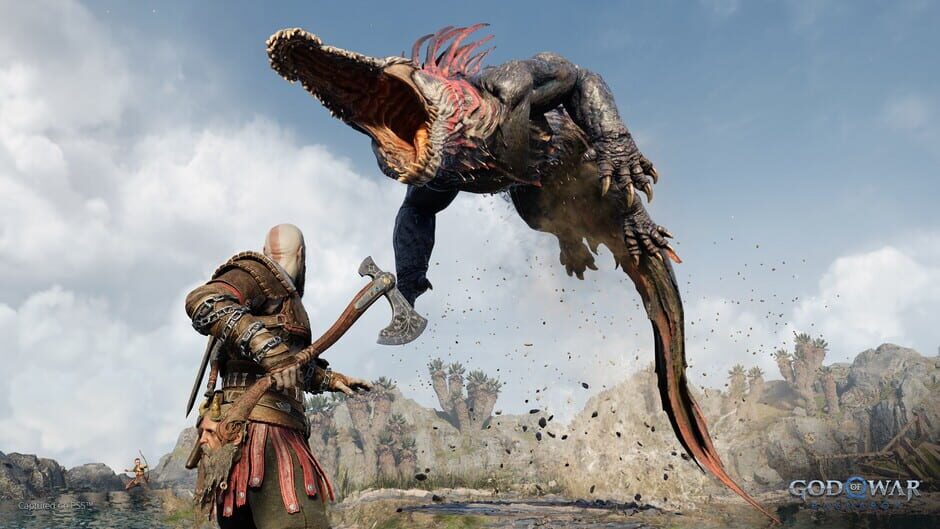
With near-perfect execution, God of War: Ragnarök is a must-play for any action fan.
91
Verdict
88%
Steam
95
IGDB
Verdict score based on confidence-adjusted Steam reviews?
Very Positive Steam reviews (88% positive)
Healthy player count of 3,074 concurrent
Critically acclaimed (95/100 critic average)
Compelling narrative and story
No significant drawbacks reported
God of War Ragnarök is a 2022 action-adventure game developed by Santa Monica Studio and published by Sony Interactive Entertainment. It was released worldwide on November 11, 2022, for both the PlayStation 4 and PlayStation 5, marking the first cross-generation release in the God of War series, and was released for Windows on September 20, 2024. It is the ninth installment in the series, the 10th chronologically, and the sequel to 2018's God of War. Loosely based on Norse mythology, the game is set in mythical ancient Scandinavia and features series protagonist, Kratos, and his now teenage son, Atreus. Concluding the Norse era of the series, the story follows Kratos and Atreus' efforts to prevent the nine realms from being destroyed by Ragnarök, the eschatological event which is central to Norse mythology and was foretold to happen in the previous game after Kratos killed the Aesir god Baldur.

Runs well on modern hardware.
Last updated 3d ago
Ragnarok is the direct sequel to 2018's Dad of War, and I purchased these games quite a while ago but finally got to my backlog and got to play these games in tandem. In total, it's around 100 hours to fully complete both games 100%. Ragnarok picks off exactly where God of War left off, and much like the previous game, starts very slow but picks up extremely quickly. Combat and gameplay is much more fluid and improved from the previous game. Graphics are just as polished and equally as hard hitting as the last. There's much more content to dive into, though I will say not all the content is fun. Necessary, but not all always fun. The Atreus gameplay will leave you very wanting, there's some partial DEI inclusion for those that care, and the sheer amount of sidequests can get a little tiresome. That being said, that's the worst of the criticism I can muster, which gives you a good indication of the game. Masterclass in story writing. Masterclass in musical score. If you're a fan of the God of War franchise, these 2 games are a must have. Highly recommended. Is it good? Yes. Is it beautiful? Yes. Is the gameplay & combat fun? Yes. Are the game mechanics better than the last game? Yes. Is the story as epic & deep as the last game? Yes. Is it worth full price? Yes. Regret spending 100 hours of my life playing these games? No. Should you buy? Yes.
Loved all 107 hours I spent on this game. By far one of the greatest releases of the decade. I know I am late to play this but a poor kid who finally got a big boy job and afforded my own devices bought my own game and finished it by myself, I'm sure many people would understand me. 100/10 game and would love to play the trilogy that's coming.
God of War Ragnarök stands as a formidable exemplar of contemporary narrative-driven game design, and to approach it merely as a sequel would be to understate its ambition. Santa Monica Studio has not simply extended the arc of Kratos and Atreus; rather, it has constructed a thematically dense and mechanically assured continuation that interrogates legacy, fate, and the burdens of parenthood with a gravitas rarely sustained at this scale. From the outset, one is struck by the game’s tonal confidence. Where its predecessor (2018) concerned itself with restraint and redefinition, Ragnarök expands outward—yet it does so without forfeiting the intimacy that defined the earlier work. The relationship between Kratos and Atreus remains the emotional fulcrum, but here it is subjected to greater strain. Atreus, no longer merely inquisitive, is increasingly assertive—occasionally reckless—and the resulting tension lends the narrative a credible emotional friction. Kratos, for his part, is rendered with a stoicism that feels earned rather than imposed; his evolution is subtle, expressed through hesitation as much as through action. The writing deserves particular commendation. Dialogue is measured, often understated, and imbued with a distinctly Nordic fatalism. Characters speak not merely to advance the plot, but to reveal philosophical positions—on destiny, agency, and consequence. Even secondary figures—Freya, Mimir, and Thor among them—are afforded a degree of psychological texture that elevates them beyond archetype. Odin, in particular, is portrayed with a disarming pragmatism, eschewing bombast in favour of calculated persuasion, which proves far more unsettling. Mechanically, the game refines rather than reinvents. Combat retains its deliberate weight, with the Leviathan Axe and Blades of Chaos offering a satisfying duality between control and aggression. The addition of new weapon dynamics and skill synergies enhances player expression without overwhelming the core system. Enemy variety is improved, though not uniformly; certain encounters verge on repetition, particularly in the mid-game segments. Nevertheless, the overall combat loop remains engaging due to its tactile feedback and strategic layering. Exploration is markedly broadened. The Nine Realms feel more distinct, both aesthetically and structurally, with environmental storytelling deployed to commendable effect. Optional content is plentiful and, crucially, meaningful. Side quests—often framed as “Favors”—frequently rival the main narrative in emotional resonance, a testament to the studio’s commitment to holistic world-building. That said, pacing occasionally falters under the weight of its own ambition. There are moments where the narrative momentum is diluted by extended traversal or auxiliary objectives that, while well-crafted, interrupt the central urgency. Visually, Ragnarök is exemplary. Art direction rather than raw graphical fidelity carries the experience, with each realm exhibiting a cohesive identity. Lighting, particle effects, and character animation coalesce to produce a world that feels both mythic and tangible. The absence of visible loading screens continues to be a technical achievement, preserving immersion throughout. The score, composed by Bear McCreary, warrants special mention. It is both grand and restrained, employing leitmotifs that evolve alongside character arcs. The music does not simply accompany the action; it contextualises it, reinforcing emotional beats with precision. If one were to levy criticism, it would centre on the game’s structural conservatism. Despite its thematic boldness, Ragnarök seldom deviates from established design conventions. Its puzzle design, while competent, rarely surprises, and certain narrative resolutions err on the side of predictability. Moreover, the sheer density of content may prove taxing for players seeking a more concise experience. Yet these reservations do little to diminish the overall achievement. God of War Ragnarök is a work of considerable craftsmanship and narrative intelligence. It balances spectacle with introspection, delivering a story that is as concerned with the inevitability of endings as it is with the possibility of change. In doing so, it affirms the medium’s capacity for mature storytelling without sacrificing the immediacy and engagement that define interactive entertainment. In sum, this is not merely a continuation—it is a culmination.
Reviews sourced from Steam. All reviews belong to their respective authors.
Data sourced from RAWG, Steam, IGDB, CheapShark, Wikipedia, HLTB, and GX Corner. Sources: rawg, steam, igdb, wikipedia.
All game titles, trademarks, and copyrights belong to their respective owners.