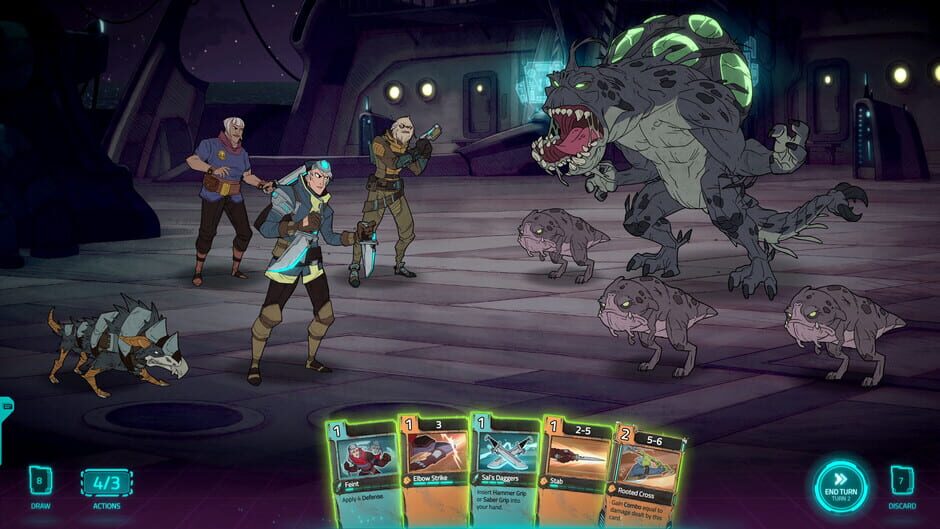
Griftlands stands out as one of the best Adventure/RPG titles in recent memory.
90
Verdict
94%
Steam
84
IGDB
Verdict score based on confidence-adjusted Steam reviews?
Very Positive on Steam (94% positive from 14K reviews)
Critically acclaimed (84/100 critic average)
No significant drawbacks reported
Griftlands is a 2021 roguelike deck-building video game developed and published by Klei Entertainment. It was initially released in early access for Microsoft Windows in June 2019; the full version of the game was released for Windows, Linux, macOS, Nintendo Switch, PlayStation 4 and Xbox One in June 2021.
Runs well on modern hardware.
Last updated 1d ago
Very good games. Competes on the level of other cards games such as Slay the Spire but with an actually good story line.
This is a fun game, I can tell I'm going to enjoy it :) It's going to take a while to learn the details of the mechanic, which is good, and I'm looking forward to seeing how my progress increases with each run. Bought on sale for excellent VFM! STEAM DECK COMPATIBILITY: If you can read the text, it works fine - you seem to mainly need the keyboard to name your 'pets' :) Could do with a little button re-mapping - X and A seem to often do the same thing, especially in conversations, so I'm constantly having to switch between them; and it took me a while to work out how the right stick worked - a small tutorial on the controls would be good as an update.
Underappreciated gem. I really enjoy how the narrative is woven into the game and the card mechanics are solid. I also enjoy how the reputation system works in that you obtain banes/boons based on what the npcs feel about your character.
Reviews sourced from Steam. All reviews belong to their respective authors.
Data sourced from RAWG, Steam, IGDB, CheapShark, Wikipedia, HLTB, and GX Corner. Sources: rawg, steam, cheapshark, igdb, wikipedia.
All game titles, trademarks, and copyrights belong to their respective owners.
