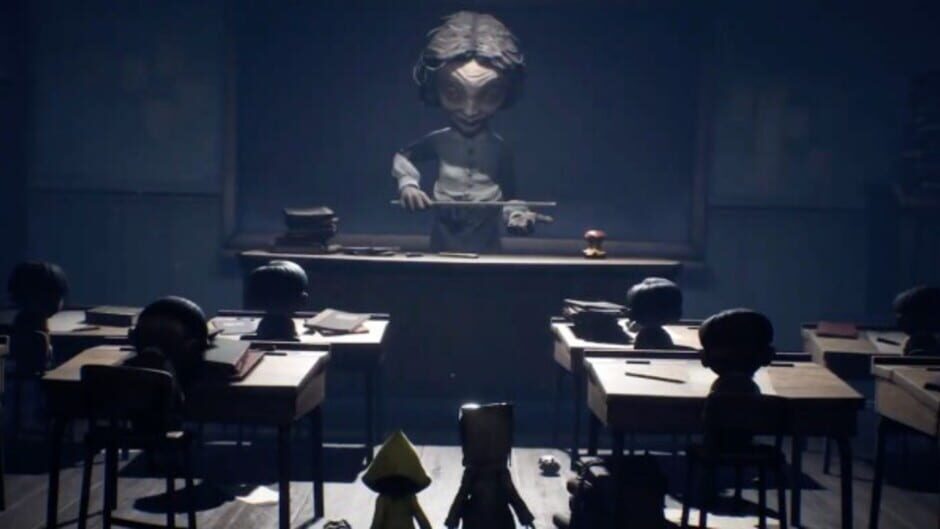
Little Nightmares II confidently hits its marks as a quality Action/Adventure title.
89
Verdict
93%
Steam
82
IGDB
Verdict score based on confidence-adjusted Steam reviews?
Very Positive on Steam (93% positive from 56K reviews)
Healthy player count of 548 concurrent
Critically acclaimed (82/100 critic average)
Compelling narrative and story
No significant drawbacks reported
Little Nightmares II is a puzzle-platform horror adventure game developed by Tarsier Studios and published by Bandai Namco Entertainment. The story follows Mono, who must work together with Six, the protagonist from Little Nightmares, to survive the horrors of the Pale City and discover its dark secrets. The game was released for Google Stadia, Nintendo Switch, PlayStation 4, Windows and Xbox One on 11 February 2021. An upgraded version, titled Little Nightmares II: Enhanced Edition, was developed by Supermassive Games and released on 25 August 2021 for PlayStation 5, Windows and Xbox Series X/S.
Runs well on modern hardware.
Last updated 1d ago
Honestly, I'd love to give this a higher rating (3.5/5, follow my Backloggd: https://backloggd.com/u/SmallElf/). Thematically, it's a step above the original. The partnership between Mono and Six is incredible; I absolutely adored them, and the range of entities you discover during your time in the Pale City is broad enough to stay interesting. But despite a jump in quality in all those areas, there was one crucial change I felt impeded the game's ability to thrive. Combat. For whatever reason, the devs decided to put a bigger focus on combat this time around. It does not work. Like, at all. Every time I'd stumble across a combat-oriented section, I would audibly sigh. It's just not the sort of game that benefits from that type of gameplay. So, unfortunately, Little Nightmares II has to get the same rating as the original. No matter how much I wish to give it 4 stars or more.
The art and the story are on par with the first one. But the game is so janky and full of bugs, all of them stemming from environment interaction. Collision in this game is your worst enemy and the spooky atmosphere disappears on your 5th try of doing something, but this time it doesn't work even though you're doing it the same way. Not to mention the many times I had to reset a level or even restart the game so that things stop bugging out. Hopefully Reanimal does not follow this trend. With a heavy heart I's giving it a NOPE.
Edit: Alright. Changing the review to positive. It really is a great game, but some game-breaking bugs killed it for me. Now it seems that all the bugs I've encountered are related to the enhanced edition only. So my very strong advice: [b]Do NOT play the enhanced edition![/b] Continuing in the same style as the original [i]Little Nightmares[/i], the visuals, creativity, story, and atmosphere are all top-notch. The enhanced edition adds ray tracing (if your system supports it), but I wish I'd played without it. The game-breaking bugs in the enhanced edition aren't worth the visual upgrade. I found the game harder than the original, especially during chase scenes. The margin for error was extremely limited, and the almost pixel-perfect requirements for getting through certain obstacles resulted in me failing certain scenes over and over. That said, I'm not very good at platforming games. There's also a bit more focus on combat events. And the same is true here. Without foreknowledge and near-perfect timing, they can become a struggle to get through. But the environments are so good. And I did want to continue on for the story and the whole vibe, as vague as it was. A note about the bugs: while playing the enhanced edition, I had to restart a chapter twice because critical items stopped spawning. Again, this doesn't seem to happen in the normal version. So ignoring those, the game is still very good.
Reviews sourced from Steam. All reviews belong to their respective authors.
Data sourced from RAWG, Steam, IGDB, CheapShark, Wikipedia, HLTB, and GX Corner. Sources: rawg, steam, igdb, wikipedia.
All game titles, trademarks, and copyrights belong to their respective owners.
