A masterclass in action design, Mark of the Ninja delivers an unforgettable experience from start to finish.
95
Verdict
97%
Steam
91
IGDB
Verdict score based on confidence-adjusted Steam reviews?
Overwhelmingly Positive on Steam (97% positive from 16K reviews)
Critically acclaimed (91/100 critic average)
Compelling narrative and story
No significant drawbacks reported
Mark of the Ninja is a side-scrolling stealth platform game developed by Klei Entertainment and published by Microsoft Studios. It was announced on February 28, 2012, and later released for the Xbox 360 via Xbox Live Arcade on September 7, 2012. The game was released for Microsoft Windows on October 16, 2012, and for Linux and OS X on September 11, 2013. A remastered version was released on October 9, 2018, for Xbox One, PlayStation 4, Nintendo Switch, Microsoft Windows, macOS, and Linux by Klei Entertainment.
Runs well on modern hardware.
Really great game, its one of those games where you can kinda suck at it but still beat it, but there's plenty of room to get better and complete levels in style. Really enjoy it, would love to see a sequel one day. Klei is a great dev.
Fun stealth side scroller, if you're into stealth games like Splinter Cell and Dishonoured but in 2D and like being a ninja, don't skip this. Make sure to get the remastered version instead of the regular version.
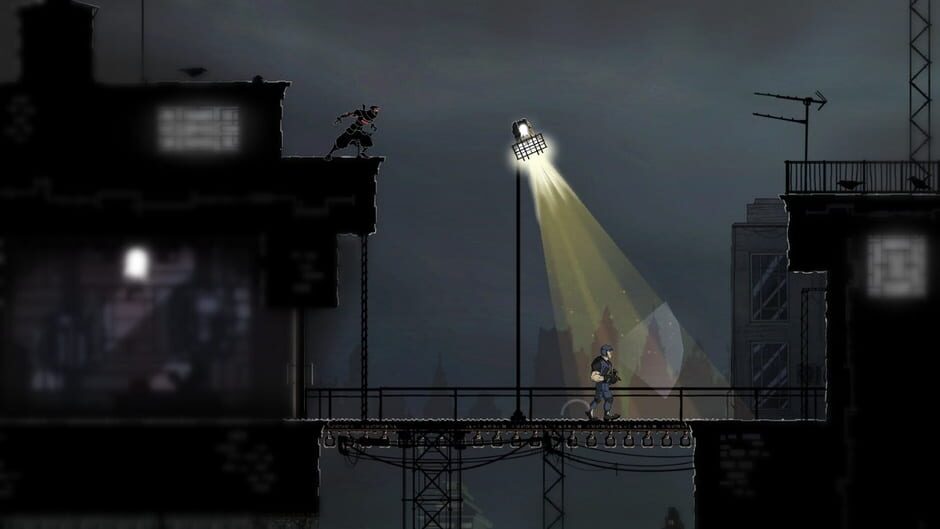
Mark of the Ninja remains one of the clearest demonstrations that a stealth game does not need a three-dimensional world to create tension, freedom, and satisfying tactical choices. Developed by Klei Entertainment and published by Microsoft Studios, it transforms the traditional side-scrolling format into a carefully designed stealth playground where observation is often more valuable than reflexes. Instead of encouraging players to charge into every encounter, the game rewards patience, clever positioning, environmental awareness, and the ability to manipulate enemies without being discovered. The story places players in control of a nameless ninja belonging to the Hisomu clan. After an attack threatens the clan, the protagonist receives special tattoos that dramatically enhance his abilities. These powers come with serious consequences, giving the otherwise straightforward revenge narrative a darker psychological element. The story is presented through stylish animated sequences that complement the hand-drawn visual direction. While the narrative is not overwhelmingly complex, it provides enough mystery and conflict to give purpose to the missions without distracting from the stealth gameplay. Stealth is unquestionably the strongest part of the experience. Darkness, noise, enemy vision, hiding places, environmental objects, and patrol routes are communicated clearly enough that players can make informed decisions. This is important because success depends heavily on understanding what guards can see and hear. Lights can expose the ninja, noises can attract attention, and careless movement can turn an apparently safe area into a dangerous situation. Instead of making these systems deliberately vague, the game provides readable visual information that allows players to learn from mistakes. Level design gives these mechanics plenty of room to work. The ninja can climb walls, hang from ceilings, move through ventilation passages, grapple toward elevated locations, hide behind objects, and approach guards from several directions. Most areas provide multiple routes, allowing cautious players to avoid enemies entirely while aggressive players can hunt guards individually. The two-dimensional perspective actually benefits this structure because players can quickly understand the layout and concentrate on developing a plan. Eliminating guards is only one solution. Distractions and psychological manipulation can be just as useful. Players can create noises, disable lights, use equipment, hide bodies, or deliberately leave evidence behind to frighten surviving enemies. Fear becomes a legitimate tactical weapon because panicked guards can behave differently from calm ones. This makes the player feel less like an action hero and more like an unseen predator controlling the situation from the shadows. Equipment and unlockable techniques further expand the possibilities. Different tools support distraction, mobility, stealth, or lethal tactics, while alternate approaches encourage experimentation across repeated playthroughs. Optional objectives and scoring systems provide additional reasons to revisit missions and attempt cleaner or more ambitious runs. A level completed through careful avoidance can feel surprisingly different when replayed using intimidation and assassinations. Combat exists, but it deliberately feels more dangerous than remaining hidden. Getting surrounded or detected can quickly destroy a carefully prepared strategy. This imbalance works because the game is fundamentally about avoiding conventional fights rather than dominating enemies through direct confrontation. Players who approach it expecting a fast action-platformer may initially find this restrictive, but those willing to engage with its stealth systems will discover considerably more depth. The presentation also contributes heavily to the experience. Its hand-drawn characters and environments have strong silhouettes that remain easy to read during dark sequences. Animation is fluid and expressive, especially during traversal and takedowns. The combination of traditional ninja imagery with modern security technology gives environments an appealing contrast without sacrificing visual consistency. Even when several guards, lights, traps, and interactive objects occupy the screen, the important information generally remains understandable. Sound is more than atmospheric decoration. Noise is integrated directly into stealth, with actions producing different levels of audible disturbance. Understanding how far sound travels is essential when distracting guards or moving through heavily protected areas. Combined with visibility mechanics, this creates a satisfying relationship between what players see, what enemies hear, and how the environment can be manipulated. The game is not without weaknesses. Some encounters eventually reuse familiar ideas, and players primarily interested in combat may find the deliberate emphasis on stealth limiting. Its focused campaign is also smaller than modern open-ended stealth games. However, the optional challenges, different play styles, scoring opportunities, collectibles, and unlockable techniques add meaningful replayability rather than simply stretching the campaign. Steam Deck compatibility is a notable advantage. The game is officially Steam Deck Verified, with its core functionality working through the handheld's controls and its interface remaining usable on the smaller display. Controller prompts and general navigation are appropriately supported, while the game can run using settings suitable for the device. Its viewpoint and methodical pacing also translate naturally to portable play, although demanding visual settings can still make sensible performance adjustments worthwhile for players prioritizing battery life or consistent performance. What ultimately makes Mark of the Ninja memorable is the consistency of its design. Movement, lighting, sound, enemy behavior, equipment, level layouts, and progression all reinforce the central fantasy of becoming an elusive ninja. It gives players enough information to construct intelligent strategies while retaining the tension that comes from knowing a single mistake can unravel an otherwise perfect infiltration. More than a decade after its original release, its approach to two-dimensional stealth still feels unusually thoughtful and refined. Rating: 9/10
Reviews sourced from Steam. All reviews belong to their respective authors.
Data sourced from RAWG, Steam, IGDB, CheapShark, Wikipedia, HLTB, and GX Corner. Sources: rawg, steam, cheapshark, igdb, wikipedia.
All game titles, trademarks, and copyrights belong to their respective owners.
