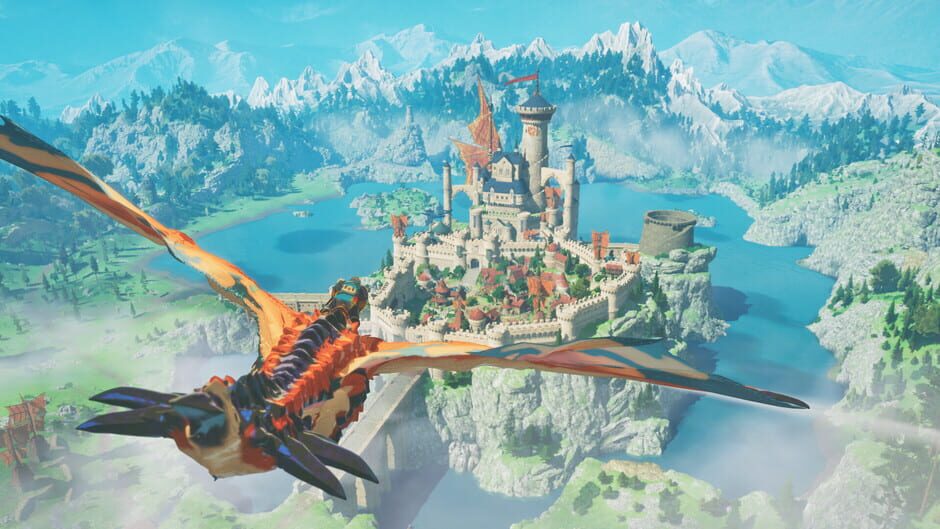
Fans of the action genre will find plenty to enjoy in Monster Hunter Stories 3: Twisted Reflection.
79
Verdict
76%
Steam
86
IGDB
Verdict score based on confidence-adjusted Steam reviews?
Mostly Positive Steam reviews (76% positive)
Active community with 20,997 concurrent players
Critically acclaimed (86/100 critic average)
No significant drawbacks reported
Monster Hunter Stories 3: Twisted Reflection is a role-playing video game in development by Capcom. It is the third major entry in the Stories sub-series within the Monster Hunter franchise, following Monster Hunter Stories (2016) and Monster Hunter Stories 2 (2021). Announced in July 2025, it was for a March 2026 release on the Nintendo Switch 2, PlayStation 5, Windows, and Xbox Series X/S.

Runs well on modern hardware.
Updated 6h ago
I would not recommend this game at full price. If you’ve played the previous entries, wait for a sale. That said, if this is your first Monster Hunter Stories game, it’s a reasonable entry point. Even though it’s the third instalment and supposedly set 200 years after the second game, you’re not really missing anything important — the gameplay loop is largely the same as before. What I Didn’t Like Story The story starts off fairly strong but becomes a mess toward the end. It steadily declines under the weight of cliché moments and nonsensical plot contrivances. Many of the high-stakes scenes get undercut just to keep the plot moving. The main character comes across as naive and often annoying, to the point that by the end I was rooting for the antagonists more than the heroes. The “bad guys” actually had more compelling reasons for their actions. Exploration Exploration is by far the worst it’s ever been in the series, especially when it comes to movement. There is no real flying — only gliding. This is almost certainly because the game hands you a fully grown Ratha right at the beginning (unlike previous games where you had to earn a flying Monstie). The environments were clearly designed around the fact that you can’t actually fly freely. Getting around is constantly annoying. Maps are full of elevation changes that block straightforward movement. In the fourth map and several other areas you’re forced to jump between glaciers and elevated rocks surrounded by water and pits. Miss a jump and you’re forced to turn around and climb back up. To make matters worse, the game includes an auto-jump feature that makes you leap off ledges if you get too close — and you can’t disable it. Absolutely infuriating. Combat Balance & Invasive Monsters Early-game monster balance felt off — they were tankier and hit harder than they should have. This largely sorted itself out after the 15–20 hour mark. The game also introduces “Invasive” monsters: bosses with specific gimmicks. These fights feel more like puzzles than strategic battles. If you don’t follow the exact criteria required to beat them, the encounters become extremely difficult or outright impossible. What I Did Like Characters Rudy is by far the best character in the game. God bless Rudy — everyone should love him. Combat Combat is the best it’s ever been across the three games. The introduction of stamina and the clear separation between kinship skills and regular abilities is an excellent change. I can’t believe they didn’t start with this system. You can finally use a wide range of skills and abilities without constantly sacrificing your kinship gauge or Dual Kinship. They replaced the Sword & Shield with a Long Blade. It’s fine — the Long Blade feels more powerful, so the change works. Presentation Character and monster designs are the strongest the series has seen, likely because Capcom is no longer constrained by the Switch hardware. The world design is also very nice, with clear visual and colour distinctions between zones that make each area feel unique. Dens Dens are finally not annoying. No more mazes, no more time-wasting. Collecting eggs and farming specific monster parts is easier than ever. The materials around dens are generous, and they added extra events inside dens (double egg nests, extra materials, tougher den fights). Main Character The protagonist finally speaks. No more silent protagonist, and they actually have a personality. We no longer rely on Navirou to carry and dictate how the main character feels or thinks. The voice acting is solid and well-used — even if I personally still find the character a bit too naïve and indecisive. The Bigger Problem Previous Monster Hunter Stories games received substantial post-launch support. So far, Stories 3 has received almost none. Combat is genuinely good, but there’s very little reason to engage with it outside the main story. The game has no real post-game content. If you value a game by how much playtime you can get relative to the money spent, Stories 3 falls short compared to its predecessors. There’s also a complete lack of multiplayer and the removal of human-vs-human battles. Both of these decisions shrink the ways you can interact with the gameplay loop. Even though I think this game is better than the previous ones in several systems, I don’t think it’s more fun. The stronger emphasis on story doesn’t make up for the loss of a more enjoyable, sandbox-style experience.
I couldn't really find my fun with this game. I haven't beaten Stories 1, but I completed Stories 2, and I enjoyed 2 a lot more than this entry. I think Stories 3 is a well made product, but I hate a lot of decisions that they made and that ultimately ruined my enjoyment of the game. Something that I heavily disagree with is how they decided to distribute the monsters. While a lot of people were happy to be able to get their favorites immediately, being able to do so defeats the point for me. I like a lot of monsters, including a bunch of the weaker and smaller ones, and while yes, I also do have favorites, if you just give them immediately then I have no reason to use anything else. Due to this, my team was finished by Chapter 3 already, meaning any motivation to raise any new monsters quickly disappeared. This is more of a warning for whoever decides to pick up this game, but this game does want you to do the side quests (and side stories) a lot. I ignored them in Stories 2, but in this game they give you a lot of unique rewards and can even unlock features, upgrade your partners and your stats permanently, etc. This is also linked to another big reason why I disliked going through this game, which is that they made the combat a lot more frustrating compared to Stories 2 (it's much harder, which can be a plus to some, but I don't think it's hard in a fun way as I feel like it didn't really match what the player's options usually are). They want you to do the sidequests and such and spend a lot of time *fully* interfacing with the game so your level doesn't fall behind. While the game is doable underleveled (that's how I did it), it's an exercise in frustration. Obviously. The game's math is very punishing, and unlike previous games where monsters did RPS attacks a lot more often, allowing you to manage your health efficiently, in this game you'll be eating undodgeable AoEs all the time. And these will also instant kill you if you're not overpowered for the encounter. It's fine, in theory, because you have three hearts (two extra lives) and unlike my experience in Stories 2, it means you get to make full use of them in this entry. You'll be losing them REALLY easily, though. This made the combat quickly devolve into "how do I play around getting oneshot?". It meant running guts decorations, having guts or evade skills on all of my weapons, equipping my monsters with the evade skill, etc. This is what I meant with how the combat doesn't really match the player's options, as keeping yourself alive can be really difficult depending on your own preference in weapons and monsters. It just feels like there's options missing (and if you're not doing every side content, there will be!) and your player character feels like they're doing nothing most of the time. But yeah, I was playing around expecting hearts to drop at mandatory points in fights, which isn't fun at all. The game's main story is actually rather short, which makes me think all of this is just in an attempt to pad out the game's playtime. The game's actually pretty grindy (used negatively here, as grinding CAN be fun), it just makes you grind every other way that isn't simply killing enemies for XP. You *can* also do that if you want to, though. TL;DR: I don't think it's a super terrible game, but it's one that expects you to interface deeply with it to make it less frustrating of a journey, but interfacing with the game isn't any fun. It's a game that wants you to 100% it, but I didn't find it any fun to. And while some people *do* prefer a lot of the changes this entry introduced, I found Stories 3 to unfortunately just be a sidegrade to Stories 2 at its very best.
TLDR: Overpriced and underdelivers, probably worth it if it's at least 50% off. I enjoyed the previous two games, so I was pretty happy to try out this game. With 3 starting out strong with a fascinating premise, it really got my hopes up within the first few hours. Unfortunately, it abandons the place where the most interesting things happen, leaving everything in a stasis for 40+ hours until the endgame. None of the core cast change, either. All the Rangers (plus Eleanor) are ideologically aligned from the start, and no one on the outside ever puts any pressure on them to change, and the only people who do need to change are confined to the opening and the endgame. Furthermore, because not a lot is really happening in the story, the sidequests end up overshadowing the main story and become less a break and more of a chore to do. The ending, however, is spectacular. Gameplay-wise, there is some good quality-of-life added, some new features that work well in some ways and not others, and some quirks in the series that I loved that were omitted entirely. For the good, monsties having any number of abilities in the field instead of being limited to a maximum of two abilities made it easier to try out different monsties without sacrificing either a core team or utility. The Rite of Channeling requires even less grinding because monsties are no longer released after the rite is performed. The best part is that releasing monsties has a purpose that isn't just making more space in the stables now. For the things I have mixed feelings about, the big one is the environment design. This time they opted for a few large and open levels with distinct areas within them that transition smoothly from one to the other, and there's far fewer labyrinthine levels (and monster dens are now just the egg nest). On one hand, the focus on large open areas means more room to run around and more diversity within a single cohesive space. On the other hand, there are fewer of these larger areas, making the game feel smaller than its predecessors. The major regions are also completely disconnected from each other. The initial arrivals happen during cutscenes, and then the only way to move between regions afterwards is by catavan. Flying has also been replaced with gliding, which doesn't feel as good as the old fly (it feels slower than a canyne's sprinting speed), but it is available from the start and does put a lot more foraging spots along the player's path in any given moment. Combat is also changed a bit, with the chance contests of strength between monster and monstie being completely absent, which is bad if you liked getting the random chance of doing extra damage to the monster, but is probably good if you prefer not having anything happen by chance. The game makes up for it by adding new mechanics in battle that are much more in the player's control. Some returning kinship skills were also changed. I only noticed it with Hunter's Claw (Arzuros skill), and I was sad to see it be a little less silly, but it probably got changed to match the more serious tone of the game. At the end of the day, is it an enjoyable game? For the most part, yes. Is it a AAA quality game worth $70? Absolutely not, and knowing the asking price for the game was such a major sticking point that made the flaws stand out that much more, even if I got it during a sale for less than that.
Reviews sourced from Steam. All reviews belong to their respective authors.
Data sourced from RAWG, Steam, IGDB, CheapShark, Wikipedia, HLTB, and GX Corner. Sources: rawg, steam, igdb, wikipedia.
All game titles, trademarks, and copyrights belong to their respective owners.