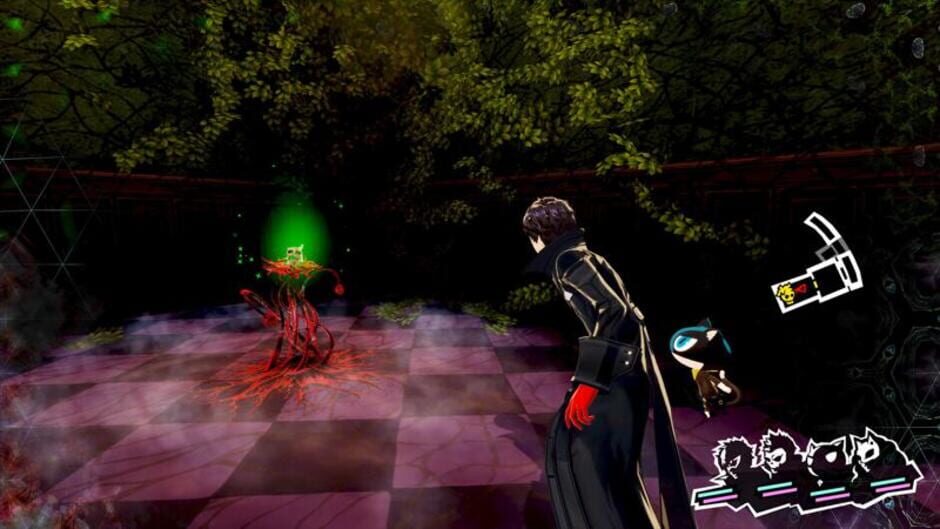
Persona 5 Royal is an exceptional Adventure/RPG that raises the bar for the genre.
95
Verdict
96%
Steam
—
IGDB
Verdict score based on confidence-adjusted Steam reviews?
Overwhelmingly Positive on Steam (96% positive from 125K reviews)
Healthy player count of 4,712 concurrent
Compelling narrative and story
Outstanding soundtrack
No significant drawbacks reported
The Launch Edition includes the game in a limited edition Steelbook case and a dynamic PS4 theme download.
Runs well on modern hardware.
Last updated 1d ago
kid with glasses gets abducted by old man in prison and told to figure out how to reform society and people, proceeds to become a national criminal in japan and then armageddon breaks loose in tokyo or something. 10/10 game
Well, that went on a bit too long... Considering my first encounter with this thing was a long time ago—with the original PS3 version, which I abandoned because I simply didn’t have the patience to put up with such a gigantic game—coupled with my steadily declining enthusiasm for the genre over the years, it’s a miracle I even gave it another shot, let alone actually made it all the way to the end. Even more surprising was that I never felt like I was dragging myself through a miserable experience with absolutely no respect for my time and that was overstaying its welcome beyond any reasonable measure. Doubly so also considering I’m nowhere near the target audience. I have several reservations about the story, but I think that once you’re hooked by the initial premise and the inexhaustible charm of the presentation and music, it’s easy to just keep going through the motions, carried along by the cozy momentum of a well-organized structure and progression, punctuated just enough by moments of excitement and twists to keep you awake whenever boredom threatens to contaminate the experience. Persona 5 Royal is easily the most complete and polished JRPG released in the last 10 years. Probably the best high-end AA made in its time, crafted with impressive competence and punching well above its weight. It’s the wet dream of teenage weebs: living out an melodramatic anime power fantasy where you fight monsters and look cool, attend a school that isn't sheer boredom, have friends who constantly fawn over you as the ultimate nice guy despite your nonexistent personality, commit fun crimes for the greater good, and—of course—kill God with the power of friendship. And it hasn’t aged a day. There’s plenty to criticize about the standardization, the compromises made in pursuit of a larger audience that blunt any edge, and the inherent limitations of creating an experience from a template, but the studio’s commitment to refining its formula has guaranteed a consistency in quality where even its most mediocre releases run circles around most rival productions. The game is a masterpiece of graphic design, an overdose of style spilling out of every inch of the screen, inviting the player in the moment they boot it up. From top to bottom, the interface is covered in this strong, omnipresent sense of aesthetics that makes even the save screen eye-catching. It’s youthful and extravagant, but in a way that neither compromises usability nor descends into the cringe of adults trying to appeal to the sensibilities of an audience they don’t understand. It has a stylized, vibrant look that translates anime aesthetics into 3D in a very particular way, supplemented by a seemingly inexhaustible gallery of memorable silhouettes, while elegantly blending animated portraits, pre-rendered backgrounds, and occasional FMVs into its compositions to maintain consistent quality and cost efficiency without ever looking cheap. Add to that one of the best soundtracks of all time, scoring every second of the game with beautiful precision, turning quieter moments with lofi beats into cozy places that make you want to just sit there and enjoy the vibe for a while, while the fiery acid jazz and jrock/metal turn the more intense moments into full-blown parties you never want to end, and you have a perfect example of a game that effortlessly outdoes productions with bigger budgets and makes you wish every game had this much personality. The combat and exploration gameplay, despite being a little on the easy side (largely because of the truckload of conveniences the game gives you), is simply great, with dungeons built around entertaining concepts—each with their own gimmicks and actually seeming to have some level of design behind them—and battles with excellent animations, a great sense of spectacle and flow, an impeccable and flashy UI, and that characteristic satisfying snappy feel that tells you the whole thing has been sharpened to near perfection. It’s the Persona with the highest degree of expressiveness, and the tuning of practically everything—number of trash encounters, damage, enemy health and versatility, item and resource drops, XP, money, etc.—is incredibly well done. Even the boss fights are good, bringing their own rules and properly testing the player’s understanding of the mechanics and ability to prepare. You can feel the money running out right after the fifth dungeon, but whatever. And then, we have the story… Most of my problems with the game lie in this part. Or rather, less with the story itself—which I consider at least tolerable and charming and which has its occasional good moments—and more with the way it is told. You get used to it eventually, but consider that you could watch several entire movies in the time it takes the game to even begin weaving the narrative of its first arc, alongside a meticulous exposition dump of a mess of Jungian concepts that justify even the clothes your character wears. HOURS spent watching cutscenes before you get the impression that the game has actually started, and even then you’re constantly kept on a very short leash, with an enormous number of interruptions to explain and re-explain things you already know. And it’s a pattern that repeats throughout the entire thing. It’s a terribly overwritten story with weak, highly patronizing writing that has absolutely no respect for your intelligence or your time. Every segment is stretched as far as it can possibly go—often undermining the drama and mystery of the plot—and the game never misses a opportunity to swallow just a few more minutes that ultimately add up to a colossal amount of hours of just empty text. It’s not "Kojima-bad," because the dialogue is at least serviceable, but without any exaggeration, three quarters of the experience could be cut without any loss. For such a long game, Persona 5 has surprisingly little to say. It dives into a series of heavy topics but develops none of them. It introduces a myriad of characters only to turn them into props with no relevance whatsoever as soon as the segment in which they were introduced are over, while the social links—obviously also dragged out to the extreme—offer bland palliatives that ultimately amount to nothing beyond a few bonuses. Not even the villains—the game’s main attraction—receive the attention they deserve for the most part. The few positive examples (especially in the third semester) only highlight how much better the game would have been if it had used all that time to enrich its characters and plot. Instead, this is the kind of story where you watch a scene and immediately afterward the characters repeat out loud what just happened. This isn’t a complex or deep story. It isn’t a story with too many characters that needs to make concessions just to tell the bare minimum. It’s simply an extraordinary demonstration of an ability to waste time beyond anything that would be reasonable in any medium—and they [i]definitely[/i] think you’re too dumb to think for yourself. Anyway, ultimately, one could go on and on about the massive conveniences the game uses as a crutch to solve its problems—the endless melodrama, the lack of tension regardless of the stakes, the game’s aversion to subtlety, and its inability to let you experience plot twists alongside the characters without spoiling everything prematurely... It’s not bad enough to become a major annoyance and outweigh how cozy it is to spend a few hours in this game, but it also doesn’t do much to elevate it. It’s just far too long for its own good. Persona 5 is more of a refinement—a natural conclusion that had been taking shape throughout the series. Despite leaving a few rough diamonds behind along the way and operating under a philosophy of excessive accessibility, it consolidates both the best and worst of this formula. It's still a fun game. P.S: My playtime is inflated by at least 30 hours.
At first you're going to complain about how long it is, at the end you're going to be left wishing it was longer. A masterpiece of a game 10/10.
Reviews sourced from Steam. All reviews belong to their respective authors.
Data sourced from RAWG, Steam, IGDB, CheapShark, Wikipedia, HLTB, and GX Corner. Sources: rawg, steam, igdb, wikipedia.
All game titles, trademarks, and copyrights belong to their respective owners.
