With near-perfect execution, Roadwarden is a must-play for any adventure fan.
93
Verdict
94%
Steam
—
IGDB
Verdict score based on confidence-adjusted Steam reviews?
Very Positive on Steam (94% positive from 4.9K reviews)
Compelling narrative and story
Standout indie gem
Limited professional critic coverage
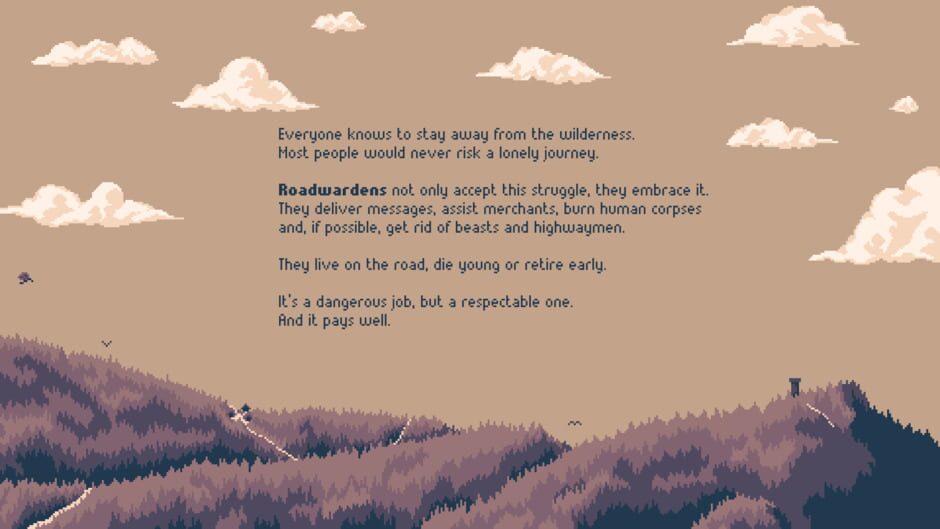
Roadwarden is a 2022 text-based role-playing and interactive fiction adventure video game for Windows, macOS, Linux, and Nintendo Switch. Developed by Moral Anxiety Studio, the game is set on a peninsula with multiple independent human settlements and features typical role-playing video game themes such as monsters and travelling bandits. The game centers on the player character, the "roadwarden", who is tasked with establishing trade and helping to secure the remote, dangerous peninsula, as well as investigating the disappearance of the previous roadwarden. Windy Meadow - A Roadwarden Tale, a game set in the same world, was released October 16, 2023.
Runs well on modern hardware.
Last updated 3d ago
This isn't really a review. I mostly want to talk directly to the writer/developer, and to anyone interested in writing, about something very specific in Roadwarden's writing. I genuinely think it's one of the main things holding the game back from being something of a masterpiece. I'm not saying [i]"write better."[/i] I'm trying to explain precisely where the writing loses its grip and what I think would make it stronger (in the hope that it's useful to anyone who reads this). [hr][/hr] First, the good: the worldbuilding is phenomenal. The world feels deep, interconnected, and full of things worth discovering. More importantly, the way you interact with it is unusually ambitious. Being a text-based game means you can have an enormous range of interactions without needing an animation or art asset for every possibility. You can type almost anything that comes to mind, and if it exists in the game and is even somewhat reasonable, the game reacts to what you're trying to do, even when it fails. The range of things you can attempt, and how far their consequences can reach, feels deeper than most RPGs I've ever played. Before getting into the issues, I want to stress that this isn't a problem with the writing all the time. I'd say the writing works fine for roughly 80% of the game, and toward the later parts I actually felt the prose become noticeably more competent and this problem occur much less often. It's precisely because the weaker moments stand out that I think they're worth pointing out. [h3]Spatial/Temporal Continuity and Embodiment[/h3] [b]This is the heart of my criticism: Roadwarden often gives me perfectly understandable individual details without giving me the relationships between those details that let me actually inhabit a scene.[/b] I can understand every sentence individually, yet still fail to build a clear picture of where I am, where everyone else is, how we got from one point to the next, or how one action leads into another. It's almost as though the game's isometric, distant visual perspective sometimes carries over into the writing. I feel less like I'm seeing the world through the Roadwarden's eyes and more like I'm a drone floating above the scene, or a god who can see everything at once. I know what the carpenter is doing, what the bird is doing, what someone across the room is looking at, and what happened somewhere else a moment ago, but I don't necessarily know [b]what my character is seeing, how close these things are to him, or how his attention moves from one thing to another.[/b] It's an omniscient view of a scene where I want an embodied one. Characters sometimes seem to jump between physical states. One moment someone is sitting down, then they're picking at the ground, then they're looking at the sky, then they're back to sawing a plank. None of those actions are impossible. The problem is that I don't know what connects them. Why did they look at the sky? Did something above them catch their attention? Did my character look up because they did? Are they still sitting in the same place? [b]The details are there, but the relationship between the details isn't always there.[/b] And that relationship is what lets the reader actually construct a scene rather than a list of things that happened. I just entered a scene where Helvius tells me to follow him. He dashes forward and hits a skeleton, then somehow we're back at the well and he's pointing out a corpse. I understand the sequence of sentences, but I don't really understand the scene. Where was I standing? Where was Helvius? Where was the skeleton? How did I follow him? Where was the well in relation to all of this? The game can be extremely specific about the appearance of a footprint or the color of a bird, yet sometimes the much more important information is missing: [i]where everyone actually is and what is happening around me.[/i] The temporal side of this is just as important. Sometimes I press a button and a wall of text tells me that the next several minutes happened. I don't get to go through the event with my character; I get the event afterwards, already summarized. It creates a strange feeling of being slightly behind my own character, as though I'm reading a report about something that happened to him rather than experiencing it myself. This is something [i]Disco Elysium[/i] and [i]Citizen Sleeper[/i] do exceptionally well. It's not that they necessarily have less text. You can read enormous amounts of it. But they carry you through the writing [b]paragraph by paragraph, moment by moment.[/b] Something happens, you process it, you react, something changes, and then you're carried into the next beat. You're continuously being brought along with your character instead of being handed the whole completed sequence at once. That's why I can read 500 pages of [i]Blood Meridian[/i] and be completely absorbed, then read four paragraphs of [i]Roadwarden[/i] and feel like I'm doing homework. I don't think that's a problem of length. It's a problem of [b]how the writing carries me through time.[/b] The physical descriptions suffer from the same underlying problem. Someone taps their stomach while we're talking about something serious. Why? What emotion or situation is that supposed to convey? Sometimes it feels like the characters are simply doing something every few seconds because the prose needs to describe [i]something[/i]. It's technically descriptive, and often quite specific, but specificity isn't the same thing as meaning. A physical action can make a scene feel more vivid when it is connected to the character's emotion, the environment, or what is happening around them. Otherwise it can feel arbitrary and actually interfere with the picture I'm forming. I don't think the answer is [i]"use less description."[/i] I think it's [b]use more purposeful description, and make the relationships between details do more work.[/b] Let the carpenter work on an intricately designed chair while we talk about someone he hates. Let him chip too hard when that person comes up, damage the chair, stop to examine what he's done, try to repair it, and continue the conversation. Now his work, his emotions, the physical environment, and the dialogue are all part of the same scene. The details have a relationship to each other. The same applies to larger events. When the carpenter gathers everyone in town, I'd much rather actually go through it with him: we leave the workshop, he gathers the villagers, someone asks a question, I choose whether to worry the crowd or calm them down, I see their reaction, and eventually we return inside. Instead, sometimes I choose one action and get a wall of text explaining that an entire sequence of events happened, after which I'm simply somewhere else. The game has made me the Roadwarden, but in those moments the narration turns me into a spectator of my own actions. And that's what makes this so frustrating: [b]the game itself has already solved the hard part.[/b] It gives me a world worth exploring, an enormous amount of freedom in how I interact with it, and consequences that can reach far beyond a single conversation. I don't want less writing, and I don't want less description. I want the writing to make those things cohere. I want to know where my character is standing. I want to understand what he sees when he looks up. I want to follow someone through a space rather than simply be told that he led me somewhere. I want to experience a conversation changing a person's behavior, rather than watch their hands perform an unrelated gesture between lines of dialogue. I want to go through an event with my character instead of arriving at the other side of it in a paragraph. [b]I don't need to see the whole world from above. I need to know where my feet are.[/b]
Charming game with very competent writing. The artstyle is simple, with a cohesive colour palette, but well thought out; especially the visuals of the interiors. It reminds me of those retro "choose your own adventure" type games. The characters are interesting, each with their own desires and history that you get to uncover the more you spend time with them. The world feels "full", it's fun to see how the towns connect with one another, finally forming a chaotic entirety. I was actually pleasantly surprised to see the story deal with the darker aspects of Hovlavan's past and future mark on the peninsula and how you, as the roadwarden, help them through your schemes and manipulations. Even if you try to do be the typical hero it is overshadowed by the fact that your good deeds are a debt that needs to be repaid. I would've liked to see more of that contrast tbh, I would've liked to have read more of what each town lost with their acceptance of Hovlavan's deal. The music is also good, though it gets a little bit repetitive if you get hit by a large chunk of dialogue, but maybe I'm a slow reader. Overall I liked it and would recommend it to anyone who's a fan of dnd and reading. I also like how the roadwarden loves his horse and hates walking.
Text-based game, with some interactivity with your character, it was pretty fun, my first ever text-based game, you play as a Roadwarden, a dude that patrols the roads, and it's your choice whether you wanna help people or not, do something or not, it was pretty fun, at times confusing with the character names, creature names, and overall in the land of the nameless peninsula. Also did not help when I would not play for a couple of days, then go back into it, completely forgetting what I'm supposed to do, there is a quest journal which kinda helps, but what helped me was the journal in which you can write your own stuff, with that, it made me know where I left off and where to go next. 8/10
Reviews sourced from Steam. All reviews belong to their respective authors.
Data sourced from RAWG, Steam, IGDB, CheapShark, Wikipedia, HLTB, and GX Corner. Sources: rawg, steam, cheapshark, igdb, wikipedia.
All game titles, trademarks, and copyrights belong to their respective owners.
