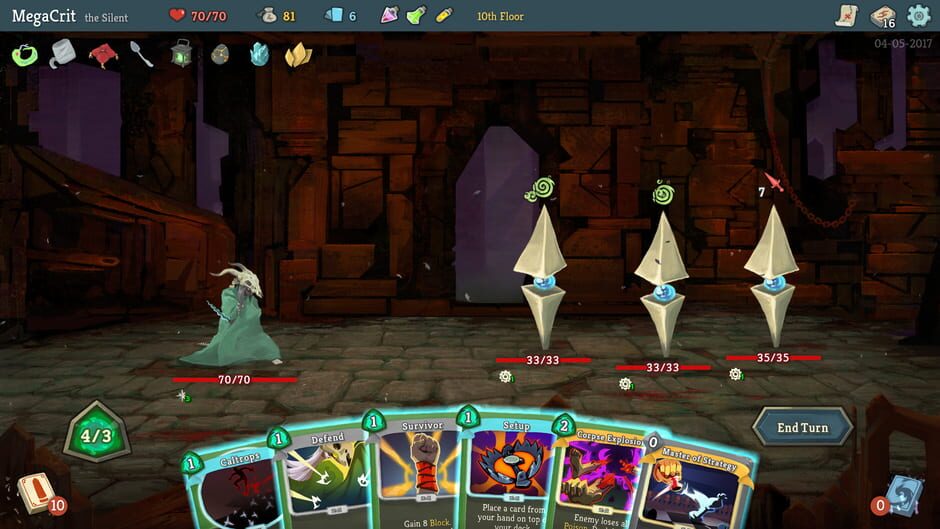
A masterclass in rpg design, Slay the Spire delivers an unforgettable experience from start to finish.
95
Verdict
98%
Steam
93
IGDB
Verdict score based on confidence-adjusted Steam reviews?
Overwhelmingly Positive on Steam (98% positive from 209K reviews)
Active community with 15,306 concurrent players
Critically acclaimed (93/100 critic average)
Standout indie gem
Still in Early Access — content may be incomplete
Slay the Spire is a 2019 roguelike deck-building game developed by the American indie studio Mega Crit. It was published by Mega Crit for its initial PC release and by Humble Bundle for home consoles and mobile platforms. The game was released in early access for Microsoft Windows, macOS, and Linux in late 2017, with an official release in January 2019. It was released for PlayStation 4 in May 2019, for Nintendo Switch in June 2019 and for Xbox One in August 2019. An iOS version was released in June 2020, with an Android version released in February 2021.
Runs well on modern hardware.
Last updated 1d ago
I try so hard and get so far, but in the end it doesn't even matter...
Probably the best deckbuilder game ever made. This game can be tied to the resurgence of card games, similar to the incredible MTG in the 90s and responsible to create a new wave of players craving for this genre. The gameplay loop is very basic, you select one of 4 possible characters (only one unlocked at the start) and begin to traverse floors until you reach an act boss. Each floor is presented with a series of different rooms that will open up or close other branches in your future decisons. Apart from the enemy battles, you can get random events, rest sites where you can recover HP or upgrade one of your cards, get permanent artifacts, etc. The game is full of RNG logically, you basically have to learn how to adapt to different strategies and circumstances instead of just sticking to what you might think is a deck that breaks the game. The very different bosses are crafted with very specific powers to be strong or weak against player builds. You need to diversify a lot if you want to have a chance on beating the game. When you start, you get access to 3 acts and a subset of the whole deck for your starter character. As you continue climbing the spire and beating the acts, you slowly get access to more cards and the other characters, each with their own deck. After years and years since this game was released, the meta is so deep that there's practically nothing overanalyzed to be discovered. Yet, as every addicting game it keeps enticing with another quick round. It also feels very balanced in general. You will still be screwed up from time to time with bad RNG, but the characters and decks feel fair. The sound design, music, the little gags and jokes everywhere, everything works perfectly in this timeless classic. It's one of those games where it's very easy to learn the rules but will take a lot of time to master, specially if you go for the hardest achievements and the true endings. If you played Monster Train and felt that it was just too complex, Slay the Spire is a much more accessible game. There's no scrolling, you can see every number onscreen at once and there's only one player character at once. A solid recommendation even if you don't enjoy deckbuilding games.
I just did not enjoy this game, unfortunately. It doesn't feel like you are rewarded for playing this game - and it also feels like whatever happens to your run feels more randomized than as a result of strategy. I've tried to get into this game multiple times, I had a few really good runs that just ended up from me forcing my momentum to stop as I've hit an immovable object. I wouldn't recommend this game personally - I would love to try to get into it, I just think there should be a more rewarding playstyle for the difficulty of this game!
Reviews sourced from Steam. All reviews belong to their respective authors.
Data sourced from RAWG, Steam, IGDB, CheapShark, Wikipedia, HLTB, and GX Corner. Sources: rawg, steam, igdb, wikipedia.
All game titles, trademarks, and copyrights belong to their respective owners.
