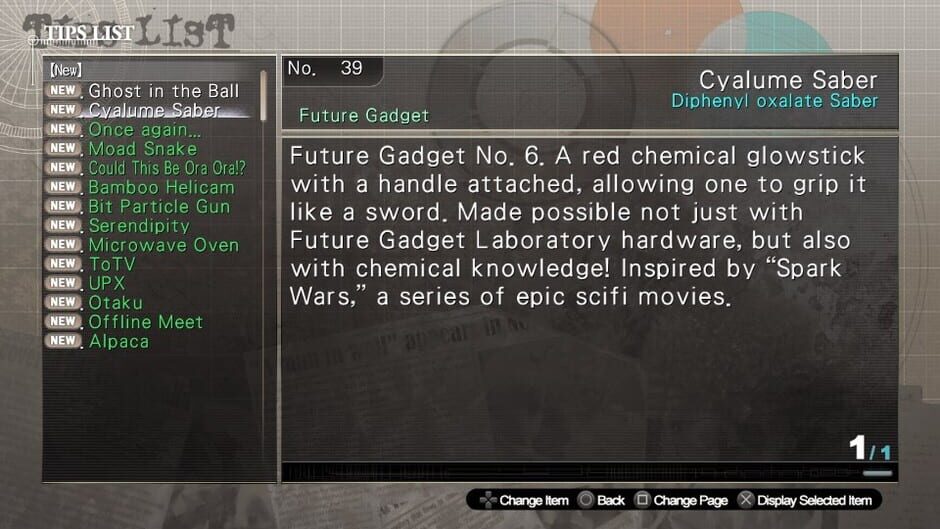
STEINS;GATE stands out as one of the best Adventure/RPG titles in recent memory.
92
Verdict
97%
Steam
80
IGDB
Verdict score based on confidence-adjusted Steam reviews?
Overwhelmingly Positive on Steam (97% positive from 25K reviews)
Critically acclaimed (80/100 critic average)
Compelling narrative and story
Outstanding soundtrack
No significant drawbacks reported
Steins;Gate is a 2009 science fiction visual novel game developed by 5pb. and Nitroplus. It is the second game in the Science Adventure series, following Chaos;Head. The story follows a group of students as they discover and develop technology that gives them the means to change the past. The gameplay in Steins;Gate includes branching scenarios with courses of interaction.

Runs well on modern hardware.
Last updated 1d ago
First of all, if you still haven’t played this game or experienced the story, do it. Blindly. Stop reading this review and play the actual game. And only after seeing the credits for the first time, look up the guide. It starts rather slowly, taking its time for the characters’ development and a bit of world-building. So, if after 2-3 chapters you find yourself wanting to quit playing - don’t. You will be rewarded. A lot. I never thought a game could wreck me this badly. A year after finishing it, I still keep coming back to it and dwelling on its themes. If you’re thinking about watching anime first, I’d recommend playing this VN first, and then watching the anime. The anime is really great, but the game simply has way more content, deeper character relationships, and more slice-of-life stuff. It’s loaded with Okabe’s inner monologues and thoughts, plus it features a bunch of alternative endings, of course. Mild spoilers follow. The big ones (including S;G 0) are hidden under spoiler tags I found S;G a year ago almost by accident. At that time, I already was deeply into theoretical physics and popular science and reading books by Hawking, Deutsch, Kaku on different theories of space-time and the nature of reality. And I’ve always been a sucker for time travel shenanigans, so when I stumbled onto S;G on Steam Summer Sale 2025 and read the description, it was an instabuy for me. I wasn’t really into anime or visual novels before, so I didn’t expect much though. While the first chapter was interesting enough to hook me, the second chapter is what made me fall in love with this story and characters, specifically, it was Kurisu’s lecture on the impossibility of time travel. And I gotta say, the whole story is built on a solid scientific foundation. There are some assumptions made here and there - otherwise it could be reality, and not sci-fi, but the science here is really elegantly crafted, and the same goes for the entire plot. Is this the best sci-fi media ever? I don’t know. But it is easily my favourite, and I’ve experienced many. And if it were only about science, it wouldn’t even be a contender for favourite. The characters and the chemistry between them are what make S;G even more special. Yeah, at first glance they are just a bunch of stereotypes. But I am actually amazed how the main characters change, and grow throughout the story. Okabe[spoiler] transforms from a so-called chuunibyou (a «mad scientist» persona, which is more like a mask hiding his true personality) to a deeply caring friend who is ready to go through hell for his friends and loved ones. Kurisu, dry and distant at the start, becomes fiercely loyal and shows a great capacity for the strongest feelings. Mayuri, a sweet childhood friend, ’an airhead’, as Okabe describes her, demonstrates the sheer depths of her emotional intelligence near the very end. Daru truly opens up in S;G 0, but even here he shines, and not just as a perv, or a random classmate to contrast the protagonist, but as a true friend - someone capable and willing to go above and beyond to help his buddies. The same goes for other lab mems, even Moeka at some point. [/spoiler] The funny thing is they are all my peers - millennials born in the early ’90s. Imagining myself as a part of their group and relating to Okabe was a total breeze since I remember myself all too well in the late 2000s. The truth is I’d love to have a circle of utterly loyal oddball friends like this lab. And yeah, speaking of the late 2000s. The atmosphere, aesthetics and the sense of that specific era are just perfect here. Akihabara, a Tokyo district, bustling in the daylight under the scorching heat yet calm, cool and even cozy at night; the lab, which is the sanctuary and the main stage at once here; the now-iconic Radio Kaikan building… Almost every location here is a beautifully drawn labor of love. Many of the locations are based on real buildings in Akihabara. Characters are still using cellphones (which will be replaced by smartphones in S;G 0) and hanging out on anon boards. They are even emailing each other (SMS-style, but still email). Oddly enough, I still love using that old-school pre-messenger long-letter style of correspondence via email myself. But here’s the thing: in S;G emails can be sent back in time. Such an email (a D-mail) can arrive years before it was sent. And change literally anything. The universe in S;G resembles Everett's many-worlds interpretation, but with one twist: worldlines don't coexist. Only one is ever real. There is an infinite number of worldlines - different ways events could unfold, grouped into attractor fields - clusters of worldlines that converge toward the same major outcomes. A D-mail works as a switch between these worldlines and, at times, the attractor fields themselves. Send a message to someone in the past, and the present will change, reconstructing itself and rewriting everyone’s memories, due to the butterfly effect. The only question is, to what extent? And all of this still haunts me. (Why? I often find myself reconsidering my past decisions and tormenting myself with what-ifs). Even a year after finishing S;G I am still pondering over some questions like what kind of D-mail would I send back to myself and to what exact point in time would I target it? Where the story hit me hardest though is [spoiler]when it becomes clear that saving Mayuri means sacrificing Kurisu, and vice versa. But the choice has to be made. And I gotta say I’ve lived through a lighter version of that choice myself: I had to choose between love and friendship, eventually losing the latter. I chose, and I've been wishing ever since that I hadn't had to. So Okabe finally makes his choice, and it’s of course heartbreaking. S;G 0 shows us later what it costs him. It also shows, briefly, what happens if he chooses differently. And it’s the same thing: nothing good, only pain. Whichever of the two you pick, you lose. And the person you did choose finds no happiness either. And that's when you reject the choice itself and go looking for that one worldline where that torturous decision never has to be made. That's what Okabe taught me: if you're being forced to choose between two agonizing options, don't. Look for the third. It may not be perfect, but most likely, it would be better.[/spoiler] This story bruteforced me to look at my own life with fresh eyes - at the events that led me here, the choices I made, and the nature of cause and effect. It gave me, a lifelong hermit, a genuine desire to reach out to people and build meaningful friendships and connections. It taught me to be braver and kinder. It also reignited my passion to study the world around me and how our universe works. And though I haven't found my own S;G worldline yet, the fact that [spoiler]Okabe did[/spoiler] gives me a bit of that tiny bittersweet hope that one day I will.
With every attempt to rewrite the past, that first summer seems a little more perfect. A journey through time that reveals the value of ordinary days only after they are gone.
Why You Must Trust the Slow Burn If you start Steins;Gate expecting non-stop adrenaline right out of the gate, you might find yourself wondering what all the hype is about during the first few chapters. Early on, the game takes its sweet time setting the stage—focusing heavily on slice-of-life interactions, quirky lab banter, chunibyo antics, and seemingly mundane text message chains. My advice to anyone picking this up: Soldier on. Do not give up on Chapters 1 through 3. What feels like a slow, casual start is actually the game meticulously building the emotional foundation you need for what comes later. Every silly conversation, phone interaction, and quiet moment in the lab is secretly laying down the emotional stakes. Once the plot officially kicks into high gear, Steins;Gate transforms into an absolute masterpiece of high-stakes temporal suspense, psychological drama, and devastating choices. The story shifts from a lighthearted sci-fi mystery into a relentless emotional rollercoaster where every decision carries immense weight. The brilliant character writing ensures that by the time tragedy strikes and the timeline starts spiraling, you are completely, deeply invested in every single member of the Future Gadget Lab. The payoff for pushing through those early chapters is unlike anything else in the genre. From heart-wrenching side routes to mind-bending plot twists and one of the most incredible final acts in video game history, Steins;Gate earns every bit of its legendary reputation. Verdict: Be patient with the slow burn. Stick with Okabe and the crew through the setup, because once the gears of fate start turning, you will not be able to put it down. It is an unforgettable experience from start to finish. Played exclusively on my phone (S24FE) through GameHub. I found it was more enjoyable since I can pick it up anytime to finish a chapter or two and stop whenever life gets in the way.
Reviews sourced from Steam. All reviews belong to their respective authors.
Data sourced from RAWG, Steam, IGDB, CheapShark, Wikipedia, HLTB, and GX Corner. Sources: rawg, steam, igdb, wikipedia.
All game titles, trademarks, and copyrights belong to their respective owners.