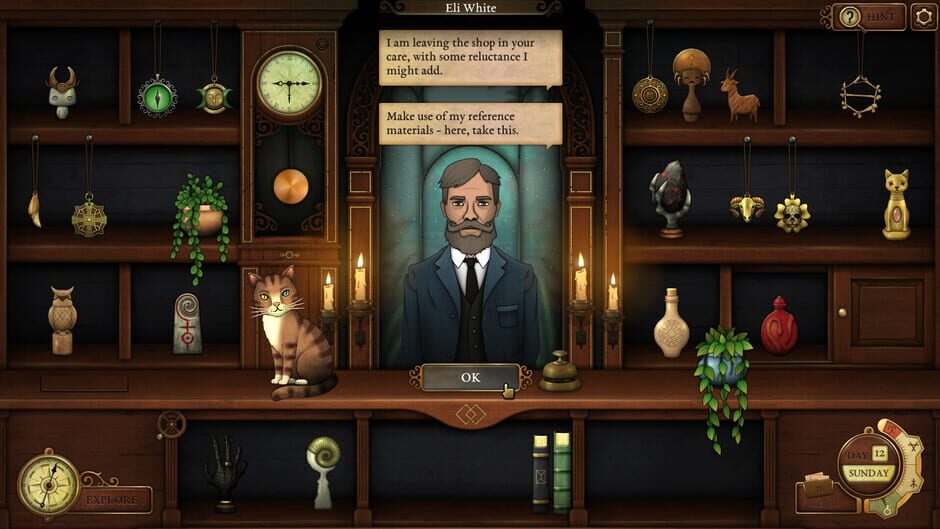
Strange Antiquities is a strong Adventure/Simulation that delivers where it counts.
89
Verdict
96%
Steam
80
IGDB
Verdict score based on confidence-adjusted Steam reviews?
Overwhelmingly Positive on Steam (96% positive from 2.8K reviews)
Critically acclaimed (80/100 critic average)
Compelling narrative and story
Rich open world to explore
No significant drawbacks reported
Strange Antiquities is a 2025 adventure video game developed by Bad Viking and published by Iceberg Interactive. It is a followup to Bad Viking's previous game, Strange Horticulture. Players run an occult shop and assist customers by solving puzzles.
Runs well on modern hardware.
Last updated 13h ago
I enjoyed the first part of *Strange Antiquities* quite a bit. The atmosphere is great, the object-identification puzzles are satisfying, and for a while it felt like the game was hitting a nice middle ground between being too easy and being annoyingly obtuse. Eventually, though, I started getting frustrated for a reason I have with a lot of puzzle games: I wasn’t always struggling with the puzzle itself, I was struggling with understanding what the game would even allow me to do. There’s a big difference between a difficult puzzle and an interface-obscure puzzle. I’m happy to spend time thinking through clues, making connections, and figuring out a solution. What I don’t enjoy is discovering that an object I’ve been looking at for hours secretly has movable parts, or that some tiny part of the screen can be manipulated even though the game never really established that as part of its vocabulary. If I had these objects physically in front of me, I could turn them over, press things, test mechanisms, or try different approaches. In a video game, I only have the actions the developer programmed, so I need some indication of what those actions are. Otherwise the challenge stops being “solve the puzzle” and becomes “guess what the developer made clickable.” That’s where the game started losing me. The actual logic often isn’t especially difficult, but some solutions feel obscure because the interaction rules aren’t communicated clearly enough. I still liked a lot about the game, but I wish it did a better job of making the available tools and interactions obvious, then letting the puzzle itself provide the difficulty.
I enjoyed this, but not as much as the first one, Strange Horticultures. I honestly wish there were a mixed/neutral rating option because I have pretty mixed feelings about this one. The overall vibe and atmosphere were really good, and I loved the sound effects and ambiance. And of course, Jupiter the cat! I loved that you could pet him AND that there was an achievement for it. I really liked the idea of the artifacts and antiques having different properties and weights, with some making noise, some being sensitive to light, and others having engravings that meant certain things. I also loved the clue cards and the different maps. I really appreciate that most of the achievements are earned naturally just by playing the game, too. You don't have to spend hours grinding for obscure achievements, which is always a huge plus for me. Unfortunately, the artifact mechanics ended up being SO tedious that about halfway through, I gave in and used a guide to finish the game and get all the achievements. Flipping through four different books and constantly checking the fields on the table got really tedious. I could never remember what things were supposed to be or look like, so I was constantly going back and forth between everything. I really wish there had been a way to screenshot or save information for reference because that would have made things so much less frustrating.
Truly one of the best games I have ever played. It is so much fun, it's staggering how much they grew from the first and brought in so many interesting ways to solve puzzles. Cannot wait for the next one.
Reviews sourced from Steam. All reviews belong to their respective authors.
Data sourced from RAWG, Steam, IGDB, CheapShark, Wikipedia, HLTB, and GX Corner. Sources: rawg, steam, cheapshark, igdb, wikipedia.
All game titles, trademarks, and copyrights belong to their respective owners.
