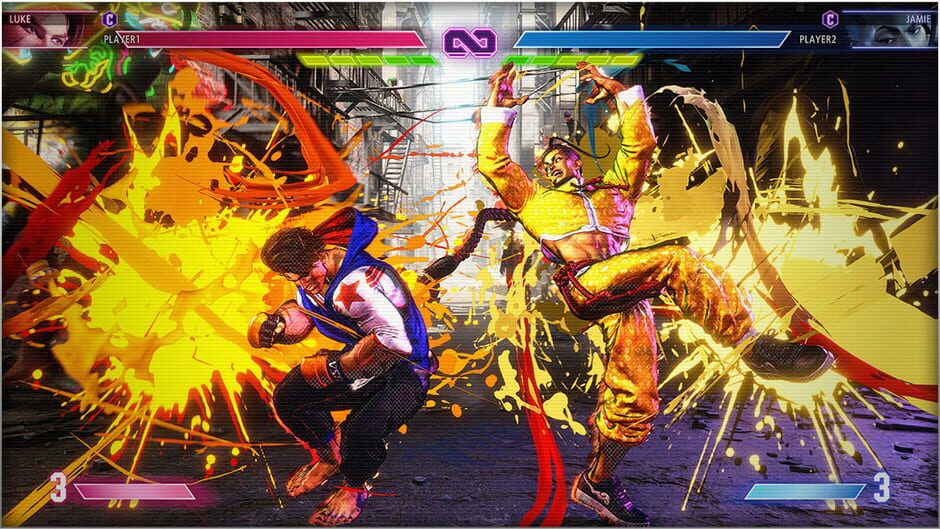
Street Fighter 6 confidently hits its marks as a quality Action/Adventure title.
87
Verdict
84%
Steam
93
IGDB
Verdict score based on confidence-adjusted Steam reviews?
Very Positive Steam reviews (84% positive)
Active community with 24,660 concurrent players
Critically acclaimed (93/100 critic average)
Rich open world to explore
Contains microtransactions
Street Fighter 6 is a 2023 fighting game developed and published by Capcom. It is the seventh main entry in the Street Fighter franchise, following Street Fighter V (2016), and was released worldwide on June 2, 2023 for PlayStation 4, PlayStation 5, Windows and Xbox Series X/S, while an arcade version, named Street Fighter 6 Type Arcade, was published by Taito for Japanese arcade cabinets in December. An updated version with post-launch content, Street Fighter 6 Years 1-2 Fighters Edition, wa...

Runs well on modern hardware.
Last updated 13h ago
A great product as a Fighting Game, but a terrible Street Fighter game. Street Fighter 6 is polished, functional, popular, and designed to succeed as a modern competitive Fighting Game. My problem is that it does not feel like a genuine Street Fighter game. It feels like Capcom created a different Fighting Game, built it around an oversized universal system, and then placed the Street Fighter name and characters on top of it. One of the biggest problems is the Drive System. Drive Rush, Drive Impact, parry, and burnout dominate nearly every aspect of the game. Instead of individual characters and their unique abilities defining each match, everyone is constantly interacting with the same universal mechanics. Some people call this depth, but to many players, it makes the cast feel homogenized. Too many matches are filled with the same Drive Rush effects, Drive Impact attempts, parries, and burnout situations. The characters still have differences, but the Drive System often feels more important than the characters themselves. Drive Rush is especially obnoxious. It turns neutral into the constant threat of an opponent suddenly sliding across the screen behind a plus-on-block normal. Drive Impact becomes less threatening at higher levels, but remains visually intrusive. Parry weakens some of the satisfaction of traditional defense. Burnout is an interesting idea, but because the Drive Gauge controls so many mechanics, the game revolves around managing one oversized resource. The presentation also tries far too hard. SF6 desperately wants to appear modern, urban, loud, stylish, accessible, and esports-ready all at once. Instead of feeling naturally cool, it feels focus-tested and manufactured. The realistic graphical direction does not help. Many characters look uncanny rather than appealing. Street Fighter works best when its characters are exaggerated, colorful, and larger than life. Pushing those proportions toward realism creates an uncanny middle ground. Street Fighter IV has bold proportions, heavy brush effects, exaggerated expressions, and a visual style that immediately stood out. Street Fighter V built on that stylized direction with more detailed models, stronger colors, and dramatic visual effects. Both games had some visual flaws, including inconsistent character models and awkward-looking faces, but their overall artistic direction remained strong. Both games understood that Street Fighter characters should look exaggerated and larger than life. The roster is another major disappointment. Street Fighter IV and Street Fighter V both have strong rosters, and I would put them roughly on par. They simply cover different sides of the series. If you want Fei Long, Gen, Dudley, Makoto, Yun, Yang, C. Viper, or Abel, you go to SF4. If you want Karin, R. Mika, Alex, Urien, Gill, Oro, Rose, or Lucia, you go to SFV. Neither roster replaces the other. SF6 instead leaves too many established fighters behind while pushing newcomers who mostly feel uninspired, overdesigned, and forgettable. New characters are not automatically bad. Every classic character was new once. But newcomers need enough personality to justify taking the spotlight. Most of SF6’s additions do not feel like future icons. They feel like focus-tested archetypes created to fill demographic and gameplay categories, while characters with decades of history and established fan followings are either missing or being held back for seasonal DLC. Despite Capcom’s enormous catalogue, this roster rarely feels like a celebration of Street Fighter’s history. It feels like legacy fighters are being replaced by nobodies and then slowly sold back to players. The monetization makes that problem worse. Capcom charges $30 for a yearly pass containing only four fighters. Four characters spread across an entire year is underwhelming, and the gaps between releases make every season feel painfully slow. With only four slots available, every choice matters. If one or two are used on guests, World Tour characters, or uninspiring newcomers, players can go an entire season without receiving anyone they wanted. Year 4 perfectly demonstrates the problem. Capcom chose Yasmine, Arjun, Tifa, and Bosch—two newcomers, a Final Fantasy VII guest, and a World Tour NPC—with no returning Street Fighter veteran. Tifa may be popular, but she does nothing to address the long list of missing legacy fighters, while Bosch feels like another attempt to force SF6’s story cast into relevance. Entering the game’s fourth year, Capcom would apparently rather dedicate an entire season to unknown characters, crossover publicity, and an NPC than bring back one veteran that longtime fans have requested. Fei Long, Balrog, Vega, Dudley, Makoto, Cody, Guy, Karin, and many others remain absent. Players are being asked to pay $30 and wait a year for four characters they may never have wanted. Year 4 does not merely fail to fix the roster problem. It proves Capcom has no urgency about fixing it. The pricing does not stop with the standard pass. Capcom also pushes a more expensive Ultimate Pass, rotating battle passes, separate premium cosmetics, and Fighter Coins—a fake-currency system that can force players to purchase more currency than they need for the item they want. Previous Street Fighter games had paid characters and expanded editions, so monetization is nothing new. The difference is that SF6 separates its content into far more layers. Players buy the full-priced game, then yearly passes, battle passes, cosmetics, and premium currency. It feels less like purchasing meaningful expansions and more like being repeatedly charged for small pieces of a game designed never to feel complete. Ironically, the game’s strongest feature is World Tour. The mode is goofy and imperfect, but it has more personality than the core competitive experience. Exploring Metro City, meeting the characters, learning their moves, and creating a custom fighter makes the Street Fighter universe feel like an actual place. World Tour shows affection for the characters and their world. The competitive side of the game, by comparison, often feels like an esports platform attached to World Tour rather than the heart of the package. The side mode understands the charm of Street Fighter better than the primary fighting system does. Everything is polished, marketed, and optimized, but the soul is missing. Street Fighter: The Movie and Street Fighter 2010 are technically worse games, but they are also strange outliers from earlier eras. Nobody sees either one as the game that defines what Street Fighter is supposed to become. Street Fighter 6 bothers me more because it is a major numbered sequel being presented as the modern future of the franchise. It has a huge budget, advanced technology, strong competitive support, and every possible advantage. Despite all of that, it feels disconnected from the identity established by the main Street Fighter games that came before it. Street Fighter: The Movie and Street Fighter 2010 can be dismissed as bizarre curiosities. Street Fighter 6 cannot. It is a full-budget identity crisis presented as the direction the entire series should follow. I am not saying people cannot enjoy it or that it has no skill, strategy, or competitive value. I am saying technical competence is not enough. A Fighting Game can be accessible and tournament-ready while still losing the personality that made its series special. Street Fighter 6 checks all the boxes of a successful modern Fighting Game. It just does not capture what I want from Street Fighter. To me, it is not necessarily a terrible Fighting Game. It is a terrible Street Fighter game.
I picked up SF6 right after xiaohai took his second EWC win. Tons of new players were jumping in around the same time, so the online environment was actually pretty solid back then. I’m not even into fighting games normally, n I’m straight up bad at most action games. But SF6 made one thing super clear right away, put in the work n u see progress instantly, with really satisfying positive feedback the whole way. modern controls opened the game up to so many more people, n brought a ton of new blood into the whole fighting game scene. Only real gripe is how expensive the characters are. I only grabbed the year 1 n 2 passes, n I’ve got zero urge to buy year 3 or 4. The base roster only has 18 characters, n most of them have way lower ceilings than the dlc ones. If u wanna get serious about the game, the dlc’s basically mandatory.
I used to like this game, back in Season 1. World Tour was especially one of the biggest draws to this game for me. However, as of Season 3's conclusion, they have completely ended any and all support for this mode, in favor of a lazy Arcade Mode ladder. While this is fine for those that like Avatar Battles as it is, it means that the mode essentially has become useless, since you don't even need to touch it at all anymore. They also never bothered to fix any of the major performance issues, even 4 years into the game, making the mode run like absolute unplayable garbage in the second half for most players. While the game's roster is decent at best, the additions with each season have been pretty lackluster and have left a whole lot to be desired. People who like the Alpha and 3 rosters especially are gutted, because we only have a grand total of 2 characters from the SF3 roster, and if you count Ingrid, only a single Alpha character. Replacements like Lily and Kimberly have been absolutely mediocre characters at best, when we could've just had the original characters. And with only 4 characters a year, which is way too slow, you can forget about getting your favorites. The worst part about this game is how deaf the developers are. Things that the community has been asking for all these years have been completely ignored, leading to the game still being the same after all this time, with the game's core mechanics being so strong that they decide if the character is strong, not the individual kits. Characters are defined by how strong their Drive Rush usage is(which has to be one of the laziest and worst mechanics I have ever seen in a fighting game, with how much of an overkill "win more" mechanic it ended up being), as well as their ability to loop throws over and over. Some characters also had their weaknesses patched by the latest patch, such as Zangief not having a low attack he could cancel into Drive Rush. He can do that now, which completely changes his gameplan. I've completely lost faith in this game. I used to absolutely love it and I would defend this game as much as I could, but I'm done with that now. I don't think it's going to get any better, and I expect this game to only get worse and worse with each season.
Reviews sourced from Steam. All reviews belong to their respective authors.
Data sourced from RAWG, Steam, IGDB, CheapShark, Wikipedia, HLTB, and GX Corner. Sources: rawg, steam, cheapshark, igdb, wikipedia.
All game titles, trademarks, and copyrights belong to their respective owners.