Supraland stands out as one of the best Action/Adventure titles in recent memory.
90
Verdict
95%
Steam
80
IGDB
Verdict score based on confidence-adjusted Steam reviews?
Overwhelmingly Positive on Steam (95% positive from 15K reviews)
Critically acclaimed (80/100 critic average)
Rich open world to explore
Still in Early Access — content may be incomplete
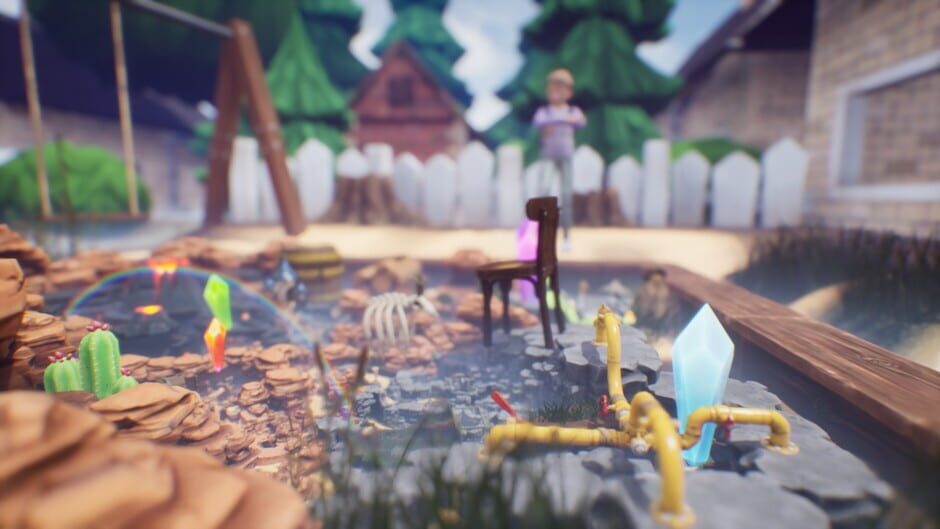
Supraland is a Metroidvania-styled video game developed by Supra Games. The game was originally self-published for PC and left early access on April 5, 2019. Ports for the eighth generation of video game consoles, with Humble Games as publisher, were released on October 22, 2020. Players assume control of a toy figurine and explore a series of themed areas within a child's sandbox.
Runs well on modern hardware.
Last updated 3d ago
I backed Supraland on Kickstarter years ago and even backed the second one, no regret at all Really feels like those old games where you see something in the distance and instantly want to go there, but you just can't yet You don't have the power, the strength or whatever you need so you know you'll come back later And the game does that really really well Every new power makes you think about all the places you couldn't reach before and you just want to go back and try again The whole tiny world is also such a cool idea, everything around you becomes huge and somehow part of the map, it's clever, funny and just fun to explore Finished it in one weekend, basically couldn't stop playing Can't wait for Supraland 2
80/100 Good but flawed puzzle platformer game. I played Supraland: 6 Inches Under (the sequel) first and it was better. This is a good puzzle-platformer with many strong points, but also some significant weaknesses. It starts out really, really strongly, with what feels like a big open world, lots of fun things to do, rapid progress, and many things to switch focus to if you can't solve a particular puzzle. In short, for quite a few hours I thought it was awesome and one of the best games I'd ever played (I mainly judge by how much fun a game is). Unfortunately over time it becomes more and more linear, with the puzzle difficulty also ramping up, and often no ability to go and do something different, which takes the fun out and makes it feel grindy and hard. A spoked world (eg like Super Mario 64) with the ability to progress by solving a certain number (percentage) of problems is more enjoyable. I found the puzzles often fiendishly hard, but all solvable, with two exceptions I will call out: -The first is the mechanic around changing the colour of your light beam to trigger the sticking out coloured bulbs (light switches) is not tutorialised or explained well. -The second is the fourth volcano area, where the puzzle with the large glass panel the size of a big swimming pool has to be solved to open the shortcut door which leads to the left of the gold and brick long ramp up to the Blue King's castle. It's only by solving this puzzle that you (a) open the shortcut door to make getting back to this volcano puzzle area simple (b) make the chest detector available and (c) spawn the shopkeeper NPC who explains the green moons, and provides a lot more detailed explanation of where the green moons are. Unfortunately due to either a bug, or really bad game design, it's possible to use the red jump pad here, which jumps you miles away, and which for me also triggered the objective changing. Instead of "get your cousin to wherever", it was now "Find the two green moons near the red crystal and use them". Trying to find the green moons with only this vague objective "find the green moons near the red crystal and use them" (which is a massive area, and the red crystal is suspended in the sky, BTW), and no chest detector, was a 6 hour exercise in frustration until I gave up and watched a Youtube video for that objective. You are completely stuck without the shopkeeper guidance (which hasn't yet triggered) "2 of the 3 green moons are missing so this door can't open. They are hidden in chests somewhere under the red crystal. This powerful tool will help you find them." And you don't use the green moons anywhere near the red crystal, even though the objective suggests you do - note that I didn't even find the relevant tree before the red jump pad took me miles away and the objective changed to "find the green moons and use them" (with no explanation of where, and without having seen the tree). Note as well, that getting back to this puzzle / 4th volcano area without the shortcut door being opened is a massive 15+ minute confusing trek each time to get to and traverse the volcano areas. Apart from that, I found all the puzzles required to complete the game often difficult but completely logical and solvable without external guidance, which is great. I really liked that the NPCs tell you that you have everything you need, or that you don't currently have everything you need for some puzzles. The hints throughout the game are really good and balanced. Another flaw of the game is that the combat is just not fun. Any PC or console game needs to have fun and enjoyable combat, and unfortunately the combat is just really clunky and disempowering. The game also cheats by which I mean your teleport gun is disabled when fighting the pair of end game bosses in the ravine, ie you can't leave a ball at the top of the ravine before starting this fight sequence (to shoot them from above, and to be able to regenerate health safely). In addition the platforming is finicky with bad physics. Monsters (and the gold coins left behind when you shoot them) can happily stand on a 55 degree slope, however you as player are frequently force-slid off trivial 20 degree slopes. Jumping onto the purple wires, or anything you're a bit close to (eg a cube) can be a pain as well. Lastly the level layout is really confusing, with poor signposting (particularly getting to the volcano area) and fast travel is not done well. There is literally no map until you complete the main game. Overall I would recommend it with the caveats above, but I would recommend the sequel more.
For what feels like a deceptively simple game that really follows a barebones structure of just explorational shovelware at the start it does a charmingly great job of showing itself off as a simple yet fully passionate goofy embracing exploration game bound by where you want to go and try to do mixed deliciously with layers of puzzle solving within it. Sort of like a homemade open world (literal) sandbox lasagna, calling it another metroidvania would be not genuine enough to how much it grew on me. Is it amazing? In some ways yes but mostly its just pretty fun, so I wouldn't say expect to have your socks blown off.
Reviews sourced from Steam. All reviews belong to their respective authors.
Data sourced from RAWG, Steam, IGDB, CheapShark, Wikipedia, HLTB, and GX Corner. Sources: rawg, steam, igdb, wikipedia.
All game titles, trademarks, and copyrights belong to their respective owners.
