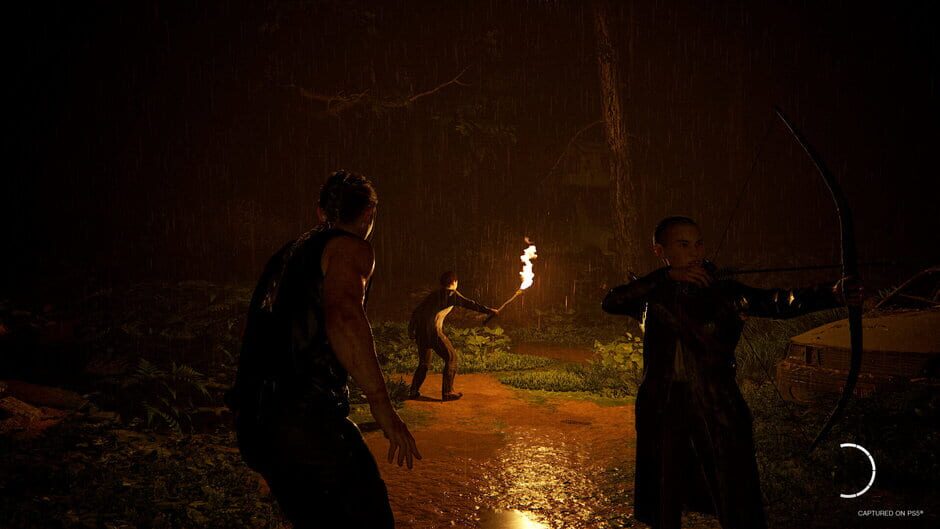
With near-perfect execution, The Last of Us Part II Remastered is a must-play for any action fan.
90
Verdict
91%
Steam
—
IGDB
Verdict score based on confidence-adjusted Steam reviews?
Very Positive on Steam (91% positive from 47K reviews)
Healthy player count of 1,677 concurrent
Compelling narrative and story
Limited professional critic coverage
Five years after their dangerous journey across the post-pandemic United States, Ellie and Joel have settled down in Jackson, Wyoming. Living amongst a thriving community of survivors has allowed them peace and stability, despite the constant threat of the infected and other, more desperate survivors. When a violent event disrupts that peace, Ellie embarks on a relentless journey to carry out justice and find closure. As she hunts those responsible one by one, she is confronted with the devastating physical and emotional repercussions of her actions.
Runs well on modern hardware.
Last updated 4d ago
this is a story about grief, not revenge. i genuinely don't know how to put into words just how much this game means to me and how much it has stuck with me. i played the last of us part I when it originally released. i've replayed it countless times over the years, especially in anticipation for part II. joel and ellie became two of the most important characters i'd ever experienced in a game. so when i say that i adore part II, i don't mean [spoiler] that i somehow didn't care about joel's death or that i was unaffected by what happened to him. quite the opposite. joel's death devastated me. it took me two years to consider picking this game back up to finish it after watching him die.[/spoiler] [spoiler] but i understood it. [/spoiler] [spoiler] and more importantly, i understood what the game was trying to say with it. [/spoiler] part II is not necessarily a story about revenge, but more a story about grief. i've experienced an almost absurd amount of loss throughout my life. from the time i was 16 through my early twenties, i lost someone that i loved, year after year. all of my grandparents, family members, and several of my cousins who were far too young to die. because of that, grief is not an abstract concept to me. i have experienced the way it can consume you, and change your personality and the trajectory of your life. the way you desperately want to move forward while simultaneously feeling incapable and overwhelming guilt for leaving someone behind. and i think the last of us part II portrays that better than almost any piece of media i've ever experienced. [spoiler] ellie isn't hunting abby because she genuinely believes that killing her will bring joel back. she knows that. she's not stupid. she's trying to escape something that she cannot escape. joel's death is stuck inside her mind, on a constant loop. she can't sleep, she can't eat, she can't function. she has a loving partner, a child, a beautiful home, and a life that is peaceful and one that should make her happy, and yet she is still drowning. [/spoiler] that is grief. it isn't rational, and it doesn't follow some neat five step progression. you don't simply become sad, cry for a while, and then move on. sometimes you're okay. sometimes you're doing better. and then a memory comes along, a song, a smell, or a thought, and it drags you all the way back down into the darkness. that is ellie. and that is why i love abby's story just as much. but walk with me. i hated abby deeply when we first met her. i wanted her dead. and then naughty dog made me live in her shoes, see the world as she does, experience it as she does. slowly, painfully, i began to understand her. did i like her? absolutely not, but i understood her. she is not a replacement for ellie, and she's not a better person by any means. she's simply another person consumed by grief, who eventually realizes that revenge doesn't bring back the person she lost. and then we have lev. watching abby find something, someone, worth protecting and living for, something beyond her own grief and desire for revenge, is one of my favorite parts of the entire game.. ellie and abby are simply mirrors of each other, just at different points in their journeys toward healing. THAT is why the ending works for me. [spoiler] ellie finally has abby at her mercy, and she lets her go. not because she suddenly forgave her, and not because joel's death doesn't matter to her anymore, but because she finally understood that killing abby is not going to bring joel back to her. for the first time, in all of this time, in all of her nightmares, she see's joel and remembers him, not as the man being beaten to death in front of her, but as the person that she deeply loved. she saw her dad. and for the first time, she chooses to let go. [/spoiler] this game devastated me, and i understand why it's so divisive. but every decision the team made to put this story together, is exactly what made this game so impactful and important to me. after playing the game three times, once normally, once on permadeath grounded, and now in chronological order, i genuinely consider it to be the most emotionally impactful pieces of media i've ever experienced. i love joel. i love ellie. and strangely, after everything, i love abby too. this game broke my heart, beat me to a pulp, made me angry and uncomfortable, and ultimately helped me to grieve my loved ones and realize that there isn't a right and wrong way to feel when you're grieving. i wouldn't change a thing. 10/10
Liked playing as Ellie, but the gameplay loop does not remain fun past like 12-14 hours, so when I got to the point I played as Abby, I was just tired of it, plus I don't really like playing the character that killed Joel, even if the game's writing team is doing everything it can to make her feel sympathetic, but there are so many dynamics she has with other characters that make what we on screen and actions she's taken past and present seem so conflicting and wholly unbelievable. They try so hard to make her seem noble, but she is clearly a sociopath through her lack of remorse, hypocrisy and cruelty that she displays throughout the game. One of the other major gripes I have with the story, is that they straight up retconned dialogue in the first game that implied that the fireflies were in the wrong to justify Abby's entire plot in 2, which lays the groundwork for her entire character's development, which is just... no, clear example of a writing sin and a major factor as to why this game is so divisive. There's alot of other stupid ♥♥♥♥ I could go on about with this game's story, as it's a massive step down from the previous game in just about every way aside from worldbuilding, which is not really hard to do with how strong the foundation from the first game was. Gameplay-wise, graphically, animation-wise, this is an insanely polished and extremely well made game, held down by it's very poorly written story and complete mishandling of some really great characters. It's also a shame that NaughtyDog has become well known for mistreating it's employees, with ridiculous crunch and layoffs, with over 70% of their staff departing post Last of Us 2 and Uncharted 4, with plenty of interviews coming out describing just how toxic this company is, as well as how much of an ego Druckman had and how he stepped over other writers and has tried to make this franchise out to his sole achievement. Narcissism like this needs to be called out more, because people like this are the worst, yet constantly get enabled because of corporate cultures and is why AAA game development has become the cesspool that it is that does not allow the flourishing and cultivation of talent like it once did, and instead you are rewarded with a swift boot to the rear end once they have wrung you dry. I appreciate all the hard work that went into this game, but when it is at the expense of the artists involved, it always leaves a sour taste in my mouth.
I loved The Last of Us. I despise what Part II does with it. My biggest problem is that this doesn't feel like a story written organically from its post-apocalyptic world. It feels like modern social activism dressed in fungal-apocalypse clothing. Humanity has been absolutely devastated. Entire cities are dead. Governments have collapsed. Communities survive behind walls and every healthy young generation represents the future of the species. That premise should raise some fascinating and uncomfortable questions about population, reproduction, family, duty and individual freedom. Instead, the game seems almost completely uninterested in them. Ellie and Dina are two healthy young women of reproductive age living in a tiny community trying to survive the end of civilisation. You don't have to conclude that Jackson would force anybody to reproduce to recognise that fertility would be an enormously important social issue in this world. Yet rather than seriously exploring any of that, we get a remarkably modern American morality play in which an old man objects to Ellie and Dina kissing, calls them a slur, gets condemned for it, and subsequently has to apologise to Ellie with his ♥♥♥♥♥♥♥ sandwiches. Really? This is what survived the apocalypse? It doesn't feel like writers asking, "What social attitudes would plausibly emerge after several decades of catastrophic population collapse?" It feels like writers taking the cultural arguments of their own time and dropping them virtually unchanged into the apocalypse. The trans material gives me much the same feeling. My objection isn't that such people magically cease to exist when civilisation collapses. Of course they don't. My objection is that the writers continually seem determined to foreground contemporary identity politics in a world that should have developed completely different priorities, pressures and social conflicts. And then there's what they did to Joel. Joel wasn't merely another character. Joel and Ellie were The Last of Us. Their relationship was the emotional foundation upon which the original game was built. So Part II takes Joel, brutally beats him to death in front of Ellie, and then makes me spend a gigantic portion of the game playing as Abby, the person who killed him. And the manipulation is painfully obvious. Look! Abby has friends. Look! Abby has people she cares about. Look! Abby has vulnerabilities. Look! Joel killed people she cared about too. Yes. I ♥♥♥♥♥♥♥ understand. The game desperately wants me to reconsider the distinction between protagonist and villain, contemplate the cycle of revenge and eventually recognise the humanity of somebody I hated. The problem is that I can see the writer standing behind the curtain pulling every lever. I don't sympathise with Abby because you force me to play as her. I don't forget what she did because you show me her relationships. And forcing me to spend hours inhabiting her perspective doesn't magically transform resentment into profound moral ambiguity. It made me resent the game. And Ellie herself becomes almost unbearable. The funny, vulnerable, sarcastic kid from the original game has become bitter, angry and frequently downright unpleasant. Obviously people change after trauma. But there's a difference between deliberately writing a damaged character and making me wonder why I should still enjoy spending forty hours around them. That's ultimately my problem with The Last of Us Part II. The first game gave me characters and allowed me to decide how I felt about them. Part II feels like it already knows the morally enlightened conclusion it wants me to reach and spends an obscene amount of time trying to drag me there. It didn't work. I didn't come away loving Abby. I didn't come away thinking destroying Joel and Ellie's relationship was profound. I didn't find the contemporary identity politics convincing within the world. And I certainly didn't mistake being lectured for sophisticated storytelling. Technically, it's extraordinary. Artistically, it's beautiful. The performances and animation are phenomenal. But storytelling isn't a graphics benchmark. The Last of Us gave me Joel and Ellie. The Last of Us Part II killed Joel, made Ellie miserable, handed me Abby and then seemed astonished that I didn't consider that an upgrade. I didn't. What a ♥♥♥♥♥♥♥ waste.
Reviews sourced from Steam. All reviews belong to their respective authors.
Data sourced from RAWG, Steam, IGDB, CheapShark, Wikipedia, HLTB, and GX Corner. Sources: rawg, steam, igdb, wikipedia.
All game titles, trademarks, and copyrights belong to their respective owners.
