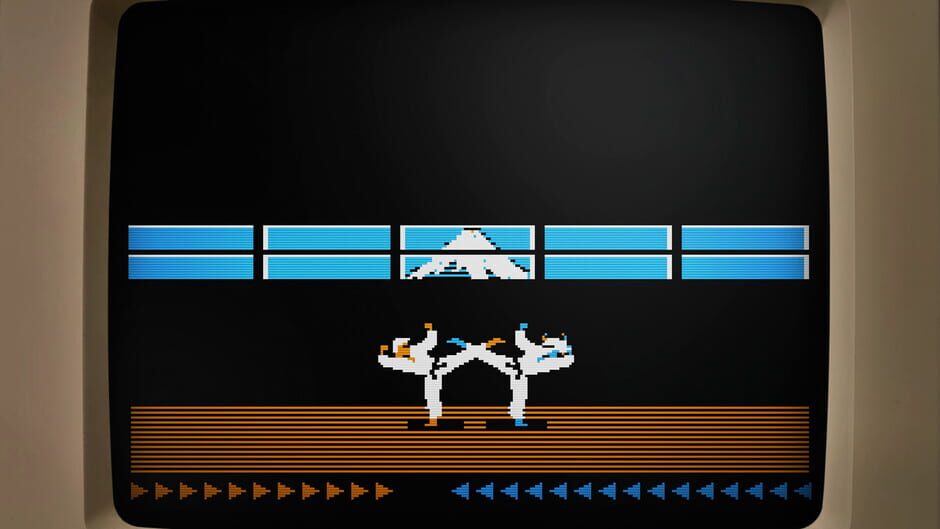
A masterclass in action design, The Making of Karateka delivers an unforgettable experience from start to finish.
91
Verdict
98%
Steam
—
IGDB
Verdict score based on confidence-adjusted Steam reviews?
Very Positive on Steam (98% positive from 125 reviews)
Compelling narrative and story
Outstanding soundtrack
Limited professional critic coverage
Play the history. Go behind the scenes of Jordan Mechner's landmark game Karateka in this interactive documentary from Digital Eclipse, with archival materials, video features, and more. Experience pixel-perfect versions of this legendary game, with all-new features.
Runs well on modern hardware.
The Making of Karateka is a fascinating example of how video game history can be preserved without reducing it to a collection of screenshots, interviews, and old software hidden behind separate menus. Developed by Digital Eclipse and published by Digital Eclipse and Atari, this interactive documentary explores the creation of Jordan Mechner’s Karateka and the experiments that eventually led to one of the most memorable early examples of cinematic game design. Instead of treating the original title as an isolated artifact, the collection reconstructs the creative journey behind it through playable prototypes, archival documents, photographs, design materials, interviews, videos, and multiple versions of the game. The central timeline is what makes the experience distinctive. Historical materials are arranged chronologically, allowing players to follow Mechner’s progression from his earliest experiments to the development of Karateka. Documents and commentary explain what was happening during different stages, while playable builds allow many of those ideas to be experienced directly. This makes the history much easier to appreciate because players are not simply being told how the game changed. They can actually interact with earlier versions and observe how mechanics, animation, presentation, and design concepts developed over time. Particularly interesting is the attention given to animation. Karateka became notable for character movement that appeared unusually fluid for its era, and the collection demonstrates how rotoscoping contributed to that result. Footage, development materials, and explanations reveal how real human movement informed the animation. These sections also demonstrate the ambitions behind the project. Mechner was interested not only in creating functional combat mechanics but also in using movement, framing, music, and visual presentation to give the action a cinematic quality. The playable historical material is one of the strongest reasons to explore the collection. Different versions and prototypes provide a practical demonstration of the development process, including experiments that would otherwise be difficult for most players to access. The original Karateka is preserved as an important part of the package, while modern features such as rewind, save functionality, and convenient navigation make vintage software considerably more approachable. These additions reduce unnecessary frustration without diminishing the historical character of the games. Karateka itself naturally feels different from contemporary fighting and action games. Movement is deliberate, combat is relatively straightforward, and the adventure is compact by modern standards. However, judging it solely through contemporary expectations misses much of its significance. Once the documentary has shown the technical limitations and design challenges involved, its animation and cinematic presentation become far more impressive. The experience provides the context necessary to understand why seemingly ordinary features represented meaningful accomplishments when the game was originally created. The collection is not restricted to straightforward preservation. Karateka Remastered provides a modern interpretation that revisits the original concept while making it more accessible to contemporary players. It complements rather than replaces the historical versions. Playing the remaster after exploring the timeline is especially satisfying because it becomes possible to recognize ideas that originated decades earlier and see how they translate into a more modern presentation. Another noteworthy component is Deathbounce: Rebounded, which revisits an unpublished project from Mechner’s earlier work. Reimagined as a twin-stick shooter, it offers faster and more immediately arcade-oriented gameplay than Karateka. More importantly, its presence strengthens the documentary's examination of creative failure and experimentation. The project illustrates that an abandoned idea can still influence a developer’s growth and eventually contribute indirectly to later success. The presentation maintains an effective balance between museum-like organization and accessibility. Archival documents retain their historical character, while interviews and commentary provide context without making the collection feel like an academic database. Personal materials also reveal the human side of development, showing the persistence, uncertainty, experimentation, and outside influences involved in turning an idea into a finished game. For anyone interested in game development, these details may ultimately prove more compelling than the finished game itself. There are understandable limitations. Players expecting a conventional action game with hours of continuous combat may be disappointed because a substantial portion of the experience involves watching, reading, examining, and comparing historical materials. Some documents will naturally appeal more strongly to enthusiasts of game history than casual players. Likewise, the original Karateka can feel mechanically restrictive compared with modern action titles. The package works best for players willing to engage with its documentary structure rather than rushing directly through the playable games. Steam Deck compatibility is generally favorable as it is rated Playable. The collection is well suited to portable play because much of the experience consists of navigating timelines, watching documentary segments, examining archival material, and playing relatively lightweight classic games. Steam Deck users should nevertheless be aware that official compatibility classifications and Proton behavior can change over time, so the current Steam Deck status should be checked directly on the device or Steam client. From a design standpoint, however, this type of collection is naturally comfortable for handheld sessions. Ultimately, The Making of Karateka succeeds because it preserves more than a finished product. It preserves the process of making that product, including prototypes, discarded concepts, technical experiments, personal influences, and the gradual refinement of ideas. Digital Eclipse presents these materials in a way that allows players to participate in the history rather than simply read about it. It is an impressive celebration of Jordan Mechner’s early work and a persuasive demonstration of what interactive video game preservation can accomplish. Rating: 9/10
Huge recommendation for this game. If you are in the Venn Diagram of "Video Game Fan", "Documentary Fan", and "General History" fan, then this game is brilliant. All of the Gold Master Series games are worth a buy as they can give a perfect blend of the medium's exploration about the medium itself. In film, you passively watch a documentary, in writing, you read an exploration of the subject, but in gaming, you can interact with old representations of the game, changes made, see design documents, and of course, if possible view 1st hand testimonial of those involved or inspired by it. BUY. THIS. GAME.
Reviews sourced from Steam. All reviews belong to their respective authors.
Data sourced from RAWG, Steam, IGDB, CheapShark, Wikipedia, HLTB, and GX Corner. Sources: rawg, steam, cheapshark, igdb.
All game titles, trademarks, and copyrights belong to their respective owners.
