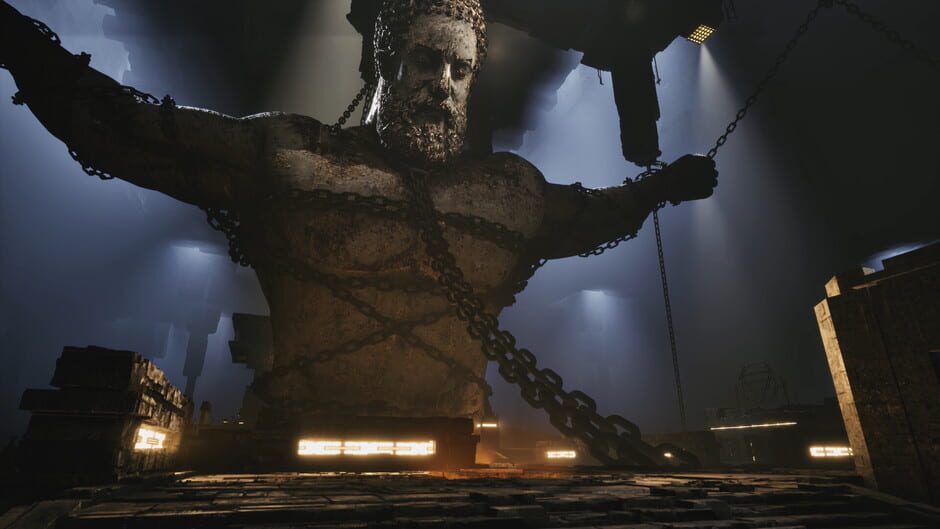
The Talos Principle 2 is an exceptional Action/Adventure that raises the bar for the genre.
93
Verdict
95%
Steam
90
IGDB
Verdict score based on confidence-adjusted Steam reviews?
Overwhelmingly Positive on Steam (95% positive from 13K reviews)
Critically acclaimed (90/100 critic average)
Compelling narrative and story
Rich open world to explore
No significant drawbacks reported
The Talos Principle 2 is a puzzle-adventure video game developed by Croteam and published by Devolver Digital. A sequel to The Talos Principle (2014), the game was released for PlayStation 5, Windows, and Xbox Series X/S in November 2023 to generally positive reviews.

Runs well on modern hardware.
Last updated 18d ago
The game takes place in a world where humanity is gone and intelligent machines have inherited what remains. Instead of focusing on survival or disaster, the game asks different questions: What happens after? What kind of future do we build? What values do we keep? The world is absolutely gorgeous. Ancient ruins stand next to futuristic structures. Forests, deserts, beaches, snowy mountains — every area feels carefully designed to make you stop and look around. More than once I found myself standing on a cliff, forgetting there was even a puzzle to solve, simply enjoying the view. I spent a lot of time wandering around, reading messages, listening to conversations, finding small secrets and checking every terminal I could find. Not because the game told me to, but because I genuinely wanted to know more about this world and the people living in it. Every new area felt like it had another story waiting to be discovered. The citizens of New Jerusalem have friendships, disagreements, hobbies, ambitions and fears. They joke with each other. They argue. They make mistakes. They love. Their conversations felt surprisingly human. Not because they act like humans, but because they struggle with the same questions we do. Some want to preserve what they have. Others want to push forward into the unknown. Some are excited about the future. Others are terrified of it. And the more I explored, the more I realized that this game isn't really about them. It's about us. About what we leave behind. About whether future generations should follow our path or create their own. About what makes a society worth building in the first place. The game doesn't spend hours trying to convince you of a single answer. Instead, it presents different perspectives and trusts you to think for yourself. The puzzles themselves are fantastic. They start simple enough to teach you the mechanics, but later become genuinely challenging. What I appreciate most is that the game rarely feels unfair. When you're stuck, it's usually because you're looking at the problem the wrong way. Some puzzles made me feel like a genius. Others made me walk around in circles for twenty minutes before realizing the solution was right in front of me. Both experiences were equally memorable. What surprised me most was how emotional the game becomes toward the end. There's so much hope and love in it. Many science-fiction stories are built around the idea that humanity will destroy itself, that technology will ruin everything or that the future is something to fear. This game acknowledges humanity's mistakes, but it also remembers our achievements. It looks at everything we've done, the good and the bad, and asks whether something better can grow from it. This is a game that trusts the player to think. A game that isn't afraid to discuss big ideas while still being entertaining. By the end, the game leaves you wondering whether the future might actually be worth looking forward to. And somehow, it feels like hope might be just enough.
I might be able to understand those that feel after many years, this game feels different to the first. For me having played game 1 for the first time, and then the second immediately after, I loved it. The first game was amazing, great puzzles and philosophy, but the lore and philosophy felt sort of bolted on the side. Game 2 felt like they had the story and world in mind to start with. The world is a lot more fleshed out than the first, it's built around a proper interactive story with voiced characters, and as someone who was itching for more lore this really delivers. There is a story to be immersed in that reveals itself to you while you complete the puzzles, instead of just reading prompts on a computer terminal. Terminals still exist and there is plenty of lore and philosophy to find within them, but the main story is going on as you experience the world, and a small amount of it can be explored outside of the puzzles. I would agree that the puzzles are slightly easier than the first game, I had to resort to youtube on 1 or 2 puzzles in game 1, but got really close to doing the same in the second so not easier by much. Don't be disappointed though, there are still star puzzles (though not quite the same), and a whole set of harder gated puzzles that you can choose to do either before or after going for the ending. Even those only unlock after doing a small set of additional puzzles, so there's a fair bit to do. For me personally I was so happy to get a lot more engrossed in the world and story, and have a good amount of it. I think if you're willing to trade a very small amount of puzzle difficulty for a lot more story world and lore, you'll love it. Can't wait for the 3rd game. Performance: Cachy OS 6700xt 3440x1440 ultrawide: 60-70fps on high settings, no frame gen, quality xess
The Talos Principle 2 is probably my favorite puzzle game and the follow up to The Talos Principle. The game starts with a short recap of the first game. Humans are extinct but before they vanished they created a simulation to create an artificial intelligence that has the same mental capacity and potential that humans had. The player solves various puzzles to escape the simulation and start a new civilization. The second game is set centuries later, the original player character, now called Athena, created other robots like herself and built a city called New Jerusalem in which all the human robots live. To honor their creators, they took on the name of humans and live on their legacy. You are the last robot to ever be created calles 1000 or 1k for short. On the day of your creation a holographic being appears and invites the citizens of New Jerusalem to a nerby island to claim something called "the flame". You and a bunch of other humans start an expedition to the island where they find a giant pyramid that they dub the megastructure. They also discover a travel system that connects to several nerby locations and when they explore the first location they realize that the entire island is full of puzzle rooms similiar to the simulation. And this is where the actual game starts, as you can expect, this is a puzzle game just like the first one but it also adds some light adventure elements to the game. But since the meat of the game are the puzzles, let's start there. As in the first game, puzzles are a mix of lasers, pressure plates, jammers and fans to open force fields until you can reach the goal. Almost all the tools from the first game have returned and the first minutes of the game lets the player in fact solve some puzzles of the simulation before leaving it to explore New Jerusalem. The puzzles on the island are an evolved form of the original puzzles. Each region introduces a new element and the puzzles of that location are usually themed after that new element, making good use of it. The first few puzzles are usually there to introoduce players to the new element and understand how it works, afterwards the puzzles become harder when that new element is used in new and interesting ways, often in combination with older elements from other locations. For example, the very first location expands the standard laser puzzles in which you have to redirect lasers to receivers of the same color. TPP1 only had red and blue lasers but TPP2 introduces green as color. But instead of just adding a green colored laser socket, in order to get green you have to combine red and green with the new RGB connector tool. But that tool not only creates green from red and blue, if you combine green (from another RGB connector) with one of the other two colors, you get the color that you didn't use. This creates much more interesting puzzles than the first game in which you have to figure out how to get specific colors exactly where you need them. A good change from the first game is the removal of some of thje more annoying elements, mainly bombs and turrets. These were no fun in my opinion, they were an obstacle created to stop players from solving puzzles and you often had to disable them in order to progress. What made them so annoying was that if you got killed, you had to restart the entire puzzle, so a slight misstep meant you had to do all the steps again until that point. This game has no such issues, you cannot die during puzzles and most puzzles are designed in away that you cannot lock yourself out of the solution if you mess up. There are a few cases where it's still possible and you have to reset, but since the puzzles overall are more compact than the first game you don't receive such big setbacks as before. While the puzzles are overall smaller, the game itself is much bigger. There are 12 explorable regions full of puzzles, each one contaioning 8 main puzzles, 2 hidden "lost puzzles", two star puzzles and a gold puzzle that opens up once yopu finished all the standard puzzles. Each location is massive but they are cleverly interconnected with signs pointing you towards the next puzzle. It will route you through the entire region and eventually loop back to the beginning where you have to create tetromino bridges to reach and activate the tower of each region. You have to solve 8 main puzzles but two can be replaced through one of the lost puzzles if you found them, those are overall harder to solve however. The star puzzles are very different this time. There are two statues on each location that require to solve a unique puzzle unmlike the main puzzles. SPhinx statues require you to find and activate hidden switches with a small picture being the only hint you get. Prometheus statues require you to find a small particle cloud and follow it back to the statue. This requires some platforming and sometimes you have to find a way to reach the cloud in an inaccessible location. The Pandora statues are the hardest, they require you to connect a laser to the statue but these lasers have to come from the main puzzles and you have to find out how. After you solves three regions, you are allowed to enter the megastructure in which you will face more puzzles but this time on a larger scale and inside a large labyrinth. These can be a bit trickier because they don't exactly follow the same rules as the standard puzzles even if they use the same elements. Outside of solving puzzles you can find and talk to your expedition members. They won't solve any puzzles for you or provide tips but they add more to the story of the game and depending on your dialog choices you will influence the story and ending of the game. Like before, this is all very philosophical with questions about what makes us human but more importantly, should we be allowed to expand humanity on the risk of destroying nature. Purpose and growth are big themes of the game. A lot of the story is told through text files, just like before, but you don't have to read them all to advance the story and having actual NPCs you can talk to this time is a refreshing change and makes the game flow much more naturally. A highlight of the game in my opinion is the exploration of New Jerusalem in the beginning, it's a big open city with several structures to explore, many NPCs to talk to and even some fun games to play. All of this is optional but it adds more charme to the game. After finishing every puzzle you unlock golden puzzles that are incredibly hard which is why they only appear at the end of the game. These are optional but unlock a better ending for the game so if you are invested into the story or simply want to challenge yourself with harder puzzles, this is the way to go. Just like the first game, the atmosphere is top notch. Beautiful landscapes and a soothing soundtrack make exploring the regions of the island a fun endavour. However, get used to a lot of walking because some regions are extremely big. I think a quick travel men that lets you move directly to puzzles you have already seen would have been welcome here. Overall I think this is a great game for any puzzle game and a perfect step up from its precedessor. If you liked the first game you will fall in love with the sequel too.
Reviews sourced from Steam. All reviews belong to their respective authors.
Data sourced from RAWG, Steam, IGDB, CheapShark, Wikipedia, HLTB, and GX Corner. Sources: rawg, steam, cheapshark, igdb, wikipedia.
All game titles, trademarks, and copyrights belong to their respective owners.