A masterclass in rpg design, Wildermyth delivers an unforgettable experience from start to finish.
92
Verdict
95%
Steam
89
IGDB
Verdict score based on confidence-adjusted Steam reviews?
Very Positive on Steam (95% positive from 18K reviews)
Critically acclaimed (89/100 critic average)
No significant drawbacks reported
Wildermyth is a tactical role-playing video game developed and published by Worldwalker Games. First released in 2019, the game was released in full in June 2021 for Linux, macOS, and Windows, and was released for Nintendo Switch, PlayStation 4, PlayStation 5, Xbox One, and Xbox Series X/S in October 2024. The game received generally positive reviews upon release, with praise mostly directed at the game's use of procedural generation for storytelling.

Runs well on modern hardware.
Last updated 19d ago
Wildermyth is a tactical RPG with an emphasis on procedural generation. It's more than the sum of its parts, and I like it. It's easy to play this game for a bit and think it's just a cute little idea decently implemented. Almost every character is randomly generated; they fight through a sort-of-XCOM short campaign in a fantasy world with a lot of random narrative events, and every character has a random personality that affects the way they behave in those events. They get even more distinct thanks to personalized gear (you can't transfer gear between characters) and various magical transformations and pets. You end up with a surprisingly well-defined roster of characters that you reuse throughout various campaigns. It's only when playing through the third and later campaigns that you get a chance to see how complex and interesting the tactical part of the game is. As the main stories of these campaigns become more complex, the randomized parts take on new meanings, and the story feels both very personalized and well-developed. I have never generated characters that ended up more memorable than my cast here. Plenty of properly written characters aren't as dear to my heart as these random people! Sadly, the magic goes away once you finish the story campaigns and play generic, randomized ones. At best, they are just about your old gang getting back together. The Omenroad DLC also doesn't feel nearly as interesting as the main game. Still, what you have here is well worth your time, just don't expect this to be your forever game. Unless, maybe, you like the setting enough to play it forever. To be frank, this kind of setting - a prehistoric world of myths - is not my cup of tea at all, and I'm surprised I liked this game as much as I did. So, I expect any fan of tactical RPGs to have a great time with it.
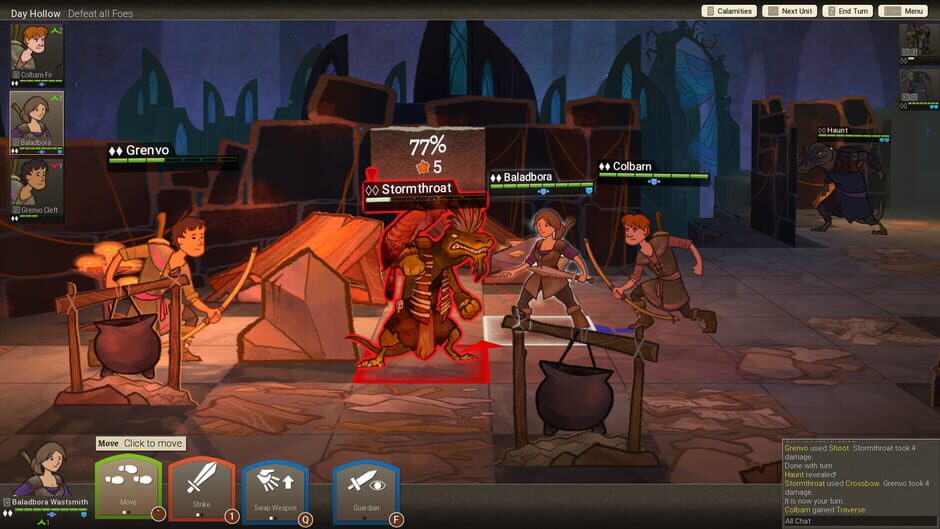
An often charming looking papercraft turn based strategy game with both set and random campaigns where your party members personality and backstories, world events, and bonds for friends/rivals/lovers create varied emergent narratives with characters having the feel of a group of tabletop roleplaying mixing both serious moments with humor. Could have been one of my favorite games, if it had more content and if much of what it offers didn't feel like unfinished ideas or rely too heavily on randomness or knowing exactly how to get events to trigger and what options the game has available to you. You start the game choosing one of the campaigns with the tutorial being three chapters and the others being five. Starting characters are created where you can roll for different bonuses in stats like speed, potency (powers many skills), dodge, block, healing rate, charisma (used in some checks and to build character relationship levels), tenacity (used in some checks), retirement age (characters retire if they reach a certain age by the end of a chapter), etc as well as taking their random appearance or altering the details you want with the characters and world having a paper crafted style to them, you can also choose gender (which I don't recall ever actually being mentioned in game) and if they are attracted to men, women, or both. You also choose three hooks that give them a quick quest to go on once per each campaign that will permanently increase their retirement age and raise their level in the current campaign, some hooks also influence the appearance of minor events. Many of the hooks offer a choice with different minor rewards for the current campaign but a few can have more like turn influence like Brash possibly leading your character to lose an eye and have an eyepatch or Integrity possibly leading you to become a skeletal creature who can no longer form any relationships but also doesn't retire, age, or suffer aging penalties while gaining a powerful magic dagger that works well as a weapon and for increasing the power of spells. The biggest influence character creation can have is choosing the levels of personality stats. You can organize traits like poet, bookish, leader, coward, greedy, loner, healer, romantic, etc in a top to bottom list where the higher the trait is set the more points go into it. These traits can influence the appearance of events, who is chosen to act in certain events, or how your character speaks (typically by the two highest traits that get the largest bonus and that your character's personality is named after). When creating a new character it either tells you the class role they will have or allows you to choose from the three. The game's classes are a warrior, hunter, and mystic and choosing a class gives you a choice between three random abilities, every level after will also allow you to choose between three abilities and give a fourth choice for an ability you can upgrade. The warrior has the most powerful build where you can take skills to become a highly maneuverable through bonus actions, multiple reaction attack taking, bonus ranged on top of bonus range from using a weapon like a spear that hits all enemies in range powerhouse that can wipe out half or more of the board in a single strike, but the warrior build also allows you to create one of the few more functional tank roles I've seen in the genre where you can stack massive amounts of armor and grab and throw enemies around. The hunter has a variety of supportive ranged attacking skills but can also focus on building their potency to use fire end poison based attacks, and their speed and ability to become invisible or regain actions on melee kills allows them to act as mobile and powerful single target melee attackers. The mystic is handled in a more interesting way than most mages where instead of casting spells they infuse with natural objects in the environment like trees, fire, metal, rocks, books, liquid, etc and can then case different spells based on the type of object they have infused with that then do damage or destroy that object. They can develop skills that give more powerful skills when infusing with certain object types and can learn to create trees or fire at will and to enhance their damage or armor based on how many objects they have infused with. While having some fun abilities they also tend to have a few that just aren't that useful due to the potential of rarely finding certain item types in the game's combat locations. Combat gives every character two actions as well as a free swift action that become normal actions if more than one is used in a turn, actions typically being a more powerful attack ability that also ends your turn or using one or both actions to move, there are also some free actions such as being able to switch between your character's two possible equipped weapons. One handed weapons can also make use of an offhand piece of equipment that can either be protective like a shield, damaging like a throwing knife or axe, or allow for more unique actions like a torch allowing you to light debris on fire. Weapons like swords give bonuses to hit and block, maces knock enemies back, spears have bonus range, daggers are weak but do double flanking damage, bows and crossbows give ranged attacks, axes break armor, staffs and wands improve your magic damage, and the two handed versions of weapons typically give bonus damage while preventing off hand equipment use. The classes work well with some fun abilities and good synergies between them and with other characters. With five different enemy factions there is a decent variety of enemies to face. Your build options are also further expanded by a few artifact weapons that may grant unique skills, transformations that can see a characters head, arms, and legs turning into certain creatures, wings and tail options that can grant active or passive bonuses as well as each character being able to have a pet option that can enhance their stats or give them a new ability and that shows up standing under the character model. The end of a campaign, death, or retirement does not have to be the end of a character/s. When a campaign ends you can choose to save or forget each character who joined your group, you can also promote one or two characters or more if you spend the legacy points you can gain in campaigns. Saved characters can be toggled on or off to possibly appear again as recruitment options in future campaigns and for every legacy tier you promote a character they can join at a higher price and having aged another two years but join with a higher level and 1-5 of their possible seven abilities saved. They will also rejoin with a small number of possible events that can influence their stats and will join with their weapons used remembered as well as any character altering features like body transformations. If you gained a transformation into a bear or wolf warrior with raven wings and a scorpion tail you will have those with that character from then on. Each character will also have their three hooks marked off as they complete them with each one granting permanent retirement bonuses and have a history section where some of the more notable things they have been part of will be recorded. Each campaign has set plot elements but not enough time is given to them to make the main narratives that interesting in the ones I've seen. Where the narrative really comes from is seeing your characters interact and be effected by events. This also becomes more of a mixed bag, more so as you play more of the game. As the campaign chapters go on.... Full Review: https://backloggd.com/u/Kennan/review/4800634/
An NPC questioned my Wizard's ability to cast the spell "Fireball," so my Wizard went ahead and created a Molotov Cocktail.
Reviews sourced from Steam. All reviews belong to their respective authors.
Data sourced from RAWG, Steam, IGDB, CheapShark, Wikipedia, HLTB, and GX Corner. Sources: rawg, steam, cheapshark, igdb, wikipedia.
All game titles, trademarks, and copyrights belong to their respective owners.