Yume Nikki stands out as one of the best Adventure/RPG titles in recent memory.
93
Verdict
94%
Steam
—
IGDB
Verdict score based on confidence-adjusted Steam reviews?
Very Positive on Steam (94% positive from 9.9K reviews)
Outstanding soundtrack
Limited professional critic coverage
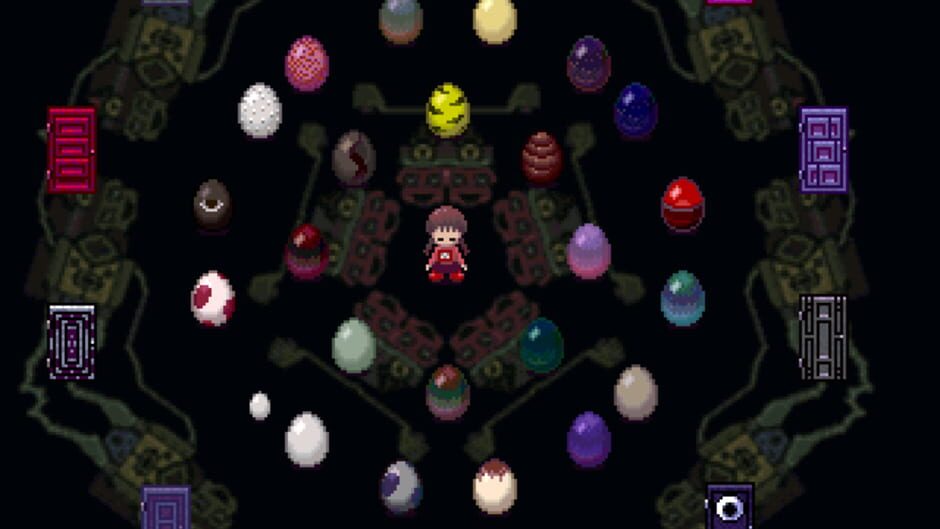
Yume Nikki is a 2004 surrealist adventure game created by the pseudonymous Japanese developer Kikiyama. The player controls a girl named Madotsuki and explores her dreams, collecting 24 effects that change her appearance and equipment. Random events also occur throughout the game in the form of cutscenes and unique gameplay sequences. The game was developed using RPG Maker 2003 without a traditional plot or battle system. Gameplay instead focuses on the exploration of the dream world.

Runs well on modern hardware.
Last updated 7d ago
8-bit walking simulator. This is probably one of the earliest games to explore the genre of weirdcore/dreamcore. There's a lot of psychological elements. I didn't realize how mainstream the music was. If you're a UT/DR fan, you can see how some of specifically Deltarune was inspired by Yume Nikki. Also i did not expect the ending at all
Yume Nikki, created by the elusive developer Kikiyama and later brought to a wider audience through its release on Steam by PLAYISM, stands as one of the most distinctive and quietly influential works to emerge from the early indie scene. Built using RPG Maker 2003, it strips away nearly every convention typically associated with video games—there are no tutorials, no dialogue-driven storytelling, no combat systems, and no clear objectives. Instead, it offers an experience centered entirely on exploration, mood, and interpretation, placing players in control of a withdrawn girl named Madotsuki as she navigates a series of surreal dreamscapes. The structure is deceptively minimal. Players begin in a small, silent apartment, where interaction is limited to a handful of objects and a single meaningful choice: going to sleep. Doing so transports Madotsuki into a dream world anchored by a central hub, often referred to as the Nexus, from which multiple doors branch into wildly different environments. Each of these dream spaces feels self-contained, governed by its own strange logic and visual identity. Some are abstract and colorful, others bleak and unsettling, and many shift tone without warning. There is no map, no guidance, and no explicit direction—progress is entirely driven by curiosity. What keeps players moving forward is the discovery of “Effects,” items hidden throughout the dream worlds that alter Madotsuki’s appearance or grant minor abilities. Yet even this goal is never explained or required in a traditional sense. The game resists the idea of completion as a checklist and instead encourages wandering, observation, and experimentation. It is entirely possible to spend long stretches simply walking through looping environments, encountering odd characters or witnessing cryptic events with no immediate explanation. In this way, Yume Nikki feels less like a structured game and more like an interactive space that players inhabit. The true strength of the experience lies in its atmosphere. The dream worlds are filled with imagery that ranges from whimsical to deeply unsettling, often blending the two in ways that feel disorienting yet strangely coherent. The minimalist pixel art, while technically simple, is used with deliberate intent, creating scenes that linger in the mind long after they are encountered. Sound design plays an equally important role, with sparse ambient audio and long periods of silence amplifying the sense of isolation. There is a constant tension between calm and unease, as if something meaningful is just out of reach but never fully revealed. Narratively, the game operates almost entirely through implication. There is no direct exposition, leaving players to interpret the meaning behind recurring symbols, environments, and events. Themes of loneliness, psychological distress, and inner conflict are often inferred, though never confirmed. This ambiguity is central to the game’s identity. It allows each player to form their own understanding of what they are experiencing, turning the act of interpretation into a core part of the gameplay. At the same time, this lack of clarity can be a barrier, particularly for those who prefer more defined storytelling. From a gameplay perspective, Yume Nikki offers very little in terms of traditional mechanics. There are no enemies, no fail states, and no conventional puzzles to solve. Interaction is limited, and progress can feel intangible. For some, this absence of structure is liberating, allowing for a purely exploratory experience free from pressure or expectation. For others, it can feel aimless, with little sense of direction or reward. The game demands patience and a willingness to engage with uncertainty, offering subtle discoveries rather than overt achievements. Despite its simplicity, the game’s impact on the indie landscape has been profound. It helped popularize a form of design that prioritizes atmosphere and emotional resonance over mechanical complexity, influencing a wide range of later titles that explore similar themes of introspection and surrealism. Its enduring appeal is reflected in the strong community that has formed around it, with players continuing to analyze, reinterpret, and discuss its meaning years after its release. Ultimately, Yume Nikki is not a game that seeks to entertain in the conventional sense. It is an experience that invites reflection, curiosity, and personal interpretation. Its lack of direction and minimal mechanics will not resonate with everyone, but for those who connect with its quiet, dreamlike approach, it offers something rare—a sense of immersion that feels intimate, unsettling, and deeply memorable. It lingers not because of what it tells you, but because of what it leaves unsaid. Rating: 9/10
words cannot express how much i LOVE this game it is one of my biggest inspirations for my art to this day!! and its so simplistic yet so effective and good. the atmosphere is great and extremely accuarate to how dreams are. and the music being mostly short loops is just so effective for this vibe as well. sadly it is not for everyone, which i understand. the "gameplay loop" (if you can even call it that) is exploring around until you find one of the effects/something cool. which might bore some people, but for me it adds to the dream-like feel! and i like being able to focus on exploring these dream areas though. my one critique is the amount of large empty void worlds, theyre a bit hard to navigate and arent a good example of the game's great vibes. i could go on and on about this game and how much it means to me, but it would take ages to write! if you like weird untraditional games that focus on vibes, this game is perfect for you!!
Reviews sourced from Steam. All reviews belong to their respective authors.
Data sourced from RAWG, Steam, IGDB, CheapShark, Wikipedia, HLTB, and GX Corner. Sources: rawg, steam, cheapshark, igdb, wikipedia.
All game titles, trademarks, and copyrights belong to their respective owners.